Kali Linux Wallpapers Full Screen Images High Quality Desktop, Laptop, Android Wallpaper.

The Modern Day Warrior: Integrating Sun Tzu’s Wisdom with Contemporary Hacking Techniques

The Modern Day Warrior: Integrating Sun Tzu’s Wisdom with Contemporary Hacking Techniques

In today’s digital landscape, the art of hacking mirrors the ancient strategies of warfare articulated by Sun Tzu in The Art of War. Just as Sun Tzu’s teachings have guided military leaders through centuries, they also offer profound insights for understanding and mastering modern hacking techniques. This article explores how Sun Tzu’s principles can be applied to the realm of contemporary hacking, turning today’s hackers into modern-day warriors.

Understanding the Battlefield: Digital Terrain

Sun Tzu’s Insight:

“Know your enemy and know yourself and you can fight a hundred battles without disaster.”

Contemporary Application: In the world of hacking, understanding the digital landscape—your “terrain”—is crucial. This includes knowledge of network architecture, software vulnerabilities, and organizational security practices. Hackers, like warriors, must thoroughly research their target systems to identify weaknesses and opportunities. This involves understanding the technology stack, potential entry points, and existing defenses.

Strategy and Planning: Preparation is Key

Sun Tzu’s Insight:

“The skillful fighter puts himself into a position which makes defeat impossible, and does not miss the moment for defeating the enemy.”

Contemporary Application: Successful hackers meticulously plan their attacks, leveraging reconnaissance to gather as much information as possible before striking. This phase involves social engineering, scanning for vulnerabilities, and mapping the target’s digital infrastructure. By preparing thoroughly, hackers can position themselves to exploit weaknesses effectively and avoid detection.

Deception and Misdirection: The Art of Distracting the Enemy

Sun Tzu’s Insight:

“All warfare is based on deception. Hence, when we are able to attack, we must seem unable; when using our forces, we must appear inactive; when we are near, we must make the enemy believe we are far away; when far away, we must make him believe we are near.”

Contemporary Application: In hacking, deception is a critical tactic. This can involve creating false trails, using fake identities, or employing misleading tactics to divert attention from the true objectives. Techniques such as phishing, where attackers disguise themselves as trustworthy entities, and planting decoy malware to mislead security teams, exemplify this principle.

Exploiting Weaknesses: Precision Strikes

Sun Tzu’s Insight:

“Attack him where he is unprepared, appear where you are not expected.”

Contemporary Application: Effective hackers identify and exploit the most vulnerable points in a system. This might involve targeting outdated software, poorly configured systems, or unpatched security holes. Precision strikes, where hackers focus on high-value targets or critical weaknesses, can lead to successful breaches with minimal effort.

Adaptability: Flexibility in Tactics

Sun Tzu’s Insight:

“Be extremely subtle, even to the point of formlessness. Be extremely mysterious, even to the point of soundlessness.”

Contemporary Application: The ability to adapt to changing conditions is crucial in hacking. Modern-day hackers must remain flexible, adjusting their tactics based on the responses and countermeasures of their targets. This could mean changing attack vectors, using new exploits, or modifying techniques in real-time to evade detection and maintain access.

Psychological Warfare: Manipulating Perceptions

Sun Tzu’s Insight:

“The greatest victory is that which requires no battle.”

Contemporary Application: Psychological manipulation is a powerful tool in hacking. By creating confusion, spreading misinformation, or exploiting human psychology, hackers can achieve their objectives without direct confrontation. Social engineering, such as convincing employees to divulge sensitive information, and leveraging psychological pressure to force compliance, illustrate the power of psychological tactics.

Defending Against Attack: Lessons in Countermeasures

Sun Tzu’s Insight:

“If you know the enemy and know yourself, you need not fear the result of a hundred battles.”

Contemporary Application: For defenders, understanding hacking tactics and techniques is as important as knowing one’s own system. This involves implementing robust security measures, continuously monitoring for threats, and staying informed about emerging vulnerabilities and attack methods. Regular security audits, employee training, and incident response planning are essential to defend against sophisticated attacks.

Conclusion: The Modern Warrior’s Path

In the digital age, hackers embody the role of the modern-day warrior, applying ancient principles of strategy and deception to navigate the complexities of cyberspace. By integrating Sun Tzu’s timeless wisdom with contemporary hacking techniques, they exemplify the fusion of historical strategy with modern technology.

Whether as attackers or defenders, understanding these principles can enhance strategic thinking and operational effectiveness. For hackers, mastering the art of modern warfare requires not only technical skills but also a deep appreciation of strategic foresight, adaptability, and psychological acumen. For defenders, embracing these lessons offers a path to stronger security and greater resilience against the evolving threats of the digital realm.

Coding Web Development Security Software Scripting Applications

Kandi PHP Web Crawler

The “Kandi 1.0 PHP Web Crawler” script is a versatile tool for web scraping, SEO analysis, and content management. It leverages PHP’s capabilities to automate the crawling process, analyze web structures, and report results. By integrating with various web technologies and tools, it supports a range of applications from SEO audits to server performance monitoring, making it a valuable asset for Full Stack Web Developers and Software Engineers.

Applications

The “Kandi 1.0 PHP Web Crawler” script is a robust web scraping tool designed to automate the extraction of links from a specified website. Leveraging PHP code and a range of web technologies, it provides valuable insights into website structures, helps monitor page loading times, and can be integrated into broader SEO and web development workflows.

Applications in Web Development and Engineering

  1. Web Scraping and Crawling:
    • Web Scraper: This script functions as a web scraper, systematically navigating a website to collect data such as internal and external links.
    • Bot Creation: Automate the collection of web data, useful for bots that interact with web pages or aggregate information.
  2. Search Engine Optimization (SEO):
    • Page Ranking and Rating: Analyze and improve SEO strategies by understanding the structure and link distribution within a website.
    • SEO Audit: Use the crawler to perform SEO audits by identifying broken links and analyzing internal link structures.
  3. Content Management Systems (CMS) and WordPress:
    • CMS Integration: Integrate the crawler with CMS platforms to automatically generate sitemaps or monitor content updates.
    • WordPress: Extract data from WordPress sites to analyze link structures or verify internal linking practices.
  4. Security and Vulnerability Assessment:
    • Security Monitoring: Identify potential vulnerabilities in link structures or page access, aiding in the assessment of web security.
    • Vulns and Vulnerabilities: Automate the discovery of security issues related to page accessibility or link integrity.
  5. Web Design and Development:
    • HTML and CSS: Analyze how links are structured within HTML and styled with CSS, ensuring consistent design practices across pages.
    • Page Loading: Monitor page loading times for performance optimization, a critical aspect of web development.
  6. Server and Database Management:
    • LAMP Server: Utilize the script on LAMP (Linux, Apache, MySQL, PHP) servers to integrate with other server-side processes and data management tasks.
    • MySQL: Extract URLs and store them in a MySQL database for further analysis or reporting.

How It Functions

Initialization and Setup

  • Form Handling:
    • User Input: Accepts a URL from the user through a form, validating the input to ensure it’s a proper URL format.
  • Timing:
    • Performance Metrics: Records the start and end times of the crawling process to calculate and display the elapsed time, providing insights into the crawler’s performance.

Crawling Process

  • Queue Management:
    • URL Queue: Manages a queue of URLs to visit, starting with the user-provided URL and expanding to include discovered links.
    • Visited URLs: Keeps track of URLs already processed to avoid duplicate crawling and ensure efficient execution.
  • HTML Content Retrieval:
    • cURL: Uses PHP’s cURL functions to fetch HTML content from each URL, handling errors and HTTP response codes to ensure valid data retrieval.
  • Link Extraction:
    • DOM Parsing: Utilizes PHP’s DOMDocument and DOMXPath classes to parse HTML and extract hyperlinks.
    • URL Resolution: Converts relative URLs to absolute URLs, maintaining consistency in link handling.
  • Depth Limitation:
    • Crawl Depth: Restricts the depth of crawling to prevent excessive or unintended traversal of the website, which can impact server performance.

Results and Reporting

  • Results Compilation:
    • Page Count: Counts the total number of unique pages crawled, providing a quantitative measure of the crawl’s scope.
    • Elapsed Time: Calculates the total time taken for the crawl, giving a performance metric for efficiency.
  • Display:
    • Web Interface: Outputs results to a web page, displaying crawled URLs, any encountered errors, and a summary of the crawl, including page count and elapsed time.

Technical Integration and Considerations

  1. Bash Scripting and Shell:
    • While not directly part of this script, bash scripting can be used in conjunction with the crawler for tasks such as scheduling crawls or processing results.
  2. Page Loading and Monitoring:
    • Page Loading: Assess the time taken to load pages, which can be crucial for performance optimization and user experience.
  3. Security:
    • Error Handling: Implements error handling to manage potential security issues during data retrieval, ensuring robust operation.
  4. CSS and HTML:
    • Style and Design: Ensures that crawled links and results are presented in a clear and styled format using CSS, enhancing the usability of the results.
  5. Netcat and Server Interactions:
    • Server Interactions: While netcat is not used here, understanding server interactions and monitoring are important for integrating this script into broader server management tasks.

Download: Kandi_1.0.zip (47.58kb)

Coding Web Development Security Software Scripting Applications

Simple Visitor Logger 2.0

Simple Visitor Logger 2.0

A simple and easy to use php Visitor Logger that saves log files in an easy to work with file and directory structure. You can customize every aspect of the logger and it adds the new Google Maps link to the Visitor Geo-Location Information. I also activated the Referring URL for this Public Version as well.

This is a Public Demo and Not Available For Download.
If you’re interested in a copy, find me.

Coding, Security & Web Development

Senya 2.0 MySQL Database Editor

Senya – MySQL Database Editor

Sleek and easy to use MySQL Database Editor.
Enter Server Configuration Manually Or Automatically From File.

By: K0NxT3D
Version: 2.0.1
URL: http://www.seaverns.com/senya/
File: Senya_2.0.zip
Senya 2.0 Files:
index.php – Main Page
display_table.php – Display MySQL Tables
update.php – Update MySQL Tables
style.css – Default Style
saved_hosts.txt – Example Autoload Configuration File

K0NxT3D

Facebook Data Centers Project

I collect a lot of data and data mining is just one of those things that I enjoy.
I build Web Crawlers and Web Scrapers often, but I really love tracking other
bots, some of which I’ve “known” for decades now.

With the ever expanding Facebook Empire, I’ve been catching a lot of the
hits from FacebookExternalHit,
[ facebookexternalhit/1.1 (+http://www.facebook.com/externalhit_uatext.php) ]
and while Facebook it’self is being overrun by nefarious bots and hacked accounts,
their problem is my solution.

The majority of the hits from FacebookExternalHit have preceded an attack, which tells me several things.
1: Facebook For Developers has given nefarious actors an edge on the Facebook user and I won’t go into detail on that, but I can make better informed security decisions based on what can be done from that side of the platform.

2: I can test my security software on both Facebook and my websites by simply posting a link to Facebook and this is really handy in my line of work. I get to see which Data Center the bot is coming from (GeoLocation), how many bots that particular Data Center has (Interesting Data There) and how fast the reaction time is, which helps determine the software being used and in which manner it’s being used.

3: Most Importantly, it gives me reasons to build new software.

So, I built this database for such purpose as to collect more data on the situation and there’s some interesting patterns developing. While it’s not exactly something I feel the urge to release, it’s worth sharing.

FBDC uses Php and MySQL, a pretty simple database and small file sizes (I like small files).
The User Input Form Works.. Ikr, a form that works??
It has a few things left to work out on the user input; I’m a big fan of getting my hands dirty,
so Updating the Data Center / BotInfo is being done via phpmyadmin until I build a better form.
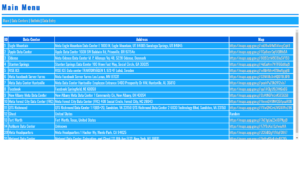
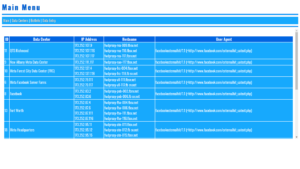
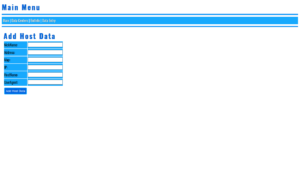
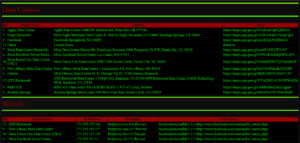
Here’s a few screenshots:

FBDC - Facebook Data Centers and FacebookExternalHit Bot Collected Data

FBDC – Facebook Data Centers and FacebookExternalHit Bot Collected Data – Main Menu


FBDC - Facebook Data Centers and FacebookExternalHit Bot Collected Data

FBDC – Facebook Data Centers and FacebookExternalHit Bot Collected Data – Data Center List


FBDC - Facebook Data Centers and FacebookExternalHit Bot Collected Data

FBDC – Facebook Data Centers and FacebookExternalHit Bot Collected Data – BotInfo List


FBDC - Facebook Data Centers and FacebookExternalHit Bot Collected Data

FBDC – Facebook Data Centers and FacebookExternalHit Bot Collected Data – User Input Form


FBDC - Facebook Data Centers and FacebookExternalHit Bot Collected Data

FBDC – Facebook Data Centers and FacebookExternalHit Bot Collected Data – Because There HAS to be a Hacker Theme too.

Russian Hackers Breach Microsoft.

Russian Hackers breached Microsoft to find out what Microsoft knows about them..

Maybe Microsoft should use Linux?

Original Article: TechCrunch

Wouldn’t you want to know what tech giants know about you?
That’s exactly what Russian government hackers want, too.

On Friday, Microsoft disclosed that the hacking group it calls Midnight Blizzard, also known as APT29 or Cozy Bear — and widely believed to be sponsored by the Russian government — hacked some corporate email accounts, including those of the company’s “senior leadership team and employees in our cybersecurity, legal, and other functions.”

PhP Header Request Spoofing Ip Address User Agent Geo-Location

Russian Hackers Hack Microsoft

Curiously, the hackers didn’t go after customer data or the traditional corporate information they may have normally gone after. They wanted to know more about themselves, or more specifically, they wanted to know what Microsoft knows about them, according to the company.

“The investigation indicates they were initially targeting email accounts for information related to Midnight Blizzard itself,” the company wrote in a blog post and SEC disclosure.

According to Microsoft, the hackers used a “password spray attack” — essentially brute forcing — against a legacy account, then used that account’s permissions “to access a very small percentage of Microsoft corporate email accounts.”

Microsoft did not disclose how many email accounts were breached, nor exactly what information the hackers accessed or stole.

Company spokespeople did not immediately respond to a request for comment.

Microsoft took advantage of news of this hack to talk about how they are going to move forward to make itself more secure.

Clowns do clownish stuff because they're clowns and that's just what clowns do.

“For Microsoft, this incident has highlighted the urgent need to move even faster. We will act immediately to apply our current security standards to Microsoft-owned legacy systems and internal business processes, even when these changes might cause disruption to existing business processes,” the company wrote. “This will likely cause some level of disruption while we adapt to this new reality, but this is a necessary step, and only the first of several we will be taking to embrace this philosophy.”

APT29, or Cozy Bear, is widely believed to be a Russian hacking group working responsible for a series of high-profile attacks, such as those against SolarWinds in 2019, the Democratic National Committee in 2015, and many more.

The Clown Show Must Go On!