DaRK Development And Research Kit 3.0 Scraper Crawler Preview Webmaster Utilities

Stand Alone Flask Application

Stand Alone Flask Application Template By K0NxT3D

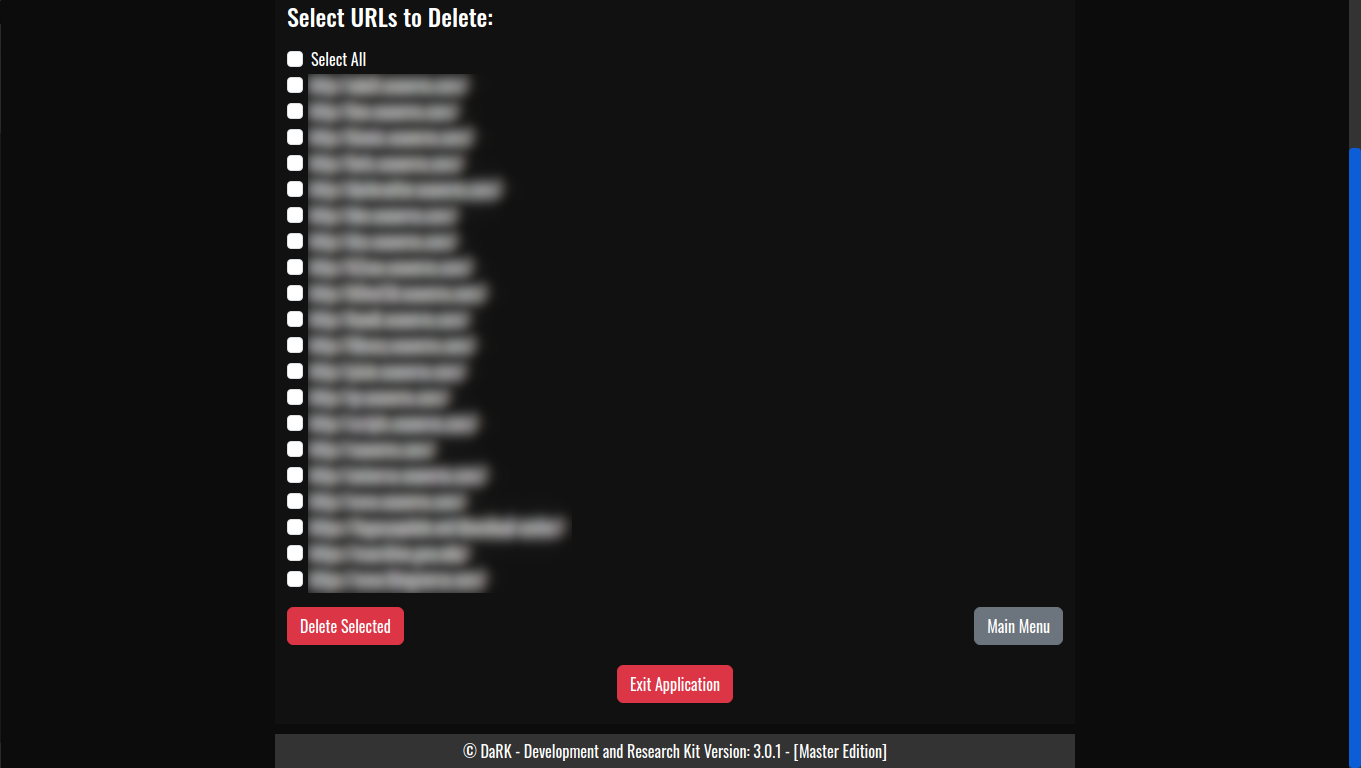
The Stand Alone Flask Application Template is a minimal yet powerful starting point for creating Flask-based web UI applications. Developed by K0NxT3D, this template is designed to run a Flask app that can be deployed easily on a local machine. It features an embedded HTML template with Bootstrap CSS for responsive design, the Oswald font for style, and a simple yet effective shutdown mechanism. Here’s a detailed look at how it works and how you can use it.


Stand Alone Flask Application – Key Features

  1. Basic Flask Setup
    The template leverages Flask, a lightweight Python web framework, to build a minimal web application. The app is configured to run on port 26001, with versioning details and a friendly app name displayed in the user interface.
  2. Embedded HTML Template
    The HTML template is embedded directly within the Flask application code using render_template_string(). This ensures that the application is fully self-contained and does not require external HTML files.
  3. Bootstrap Integration
    The application uses Bootstrap 5 for responsive UI components, ensuring that the application adapts to different screen sizes. Key elements like buttons, form controls, and navigation are styled with Bootstrap’s predefined classes.
  4. Oswald Font
    The Oswald font is embedded via Google Fonts, giving the application a modern, clean look. This font is applied globally to the body and header elements.
  5. Shutdown Logic
    One of the standout features is the built-in shutdown mechanism, allowing the Flask server to be stopped safely. The /exit route is specifically designed to gracefully shut down the server, with a redirect and a JavaScript timeout to ensure the application closes cleanly.
  6. Automatic Browser Launch
    When the application is started, the script automatically opens the default web browser to the local Flask URL. This is done by the open_browser() function, which runs in a separate thread to avoid blocking the main Flask server.

How The Stand Alone Flask Application Works

1. Application Setup

The core setup includes the following elements:

TITLE = "Flask Template"
VERSION = '1.0.0'
APPNAME = f"{TITLE} {VERSION}"
PORT = 26001
app = Flask(TITLE)

This sets the title, version, and application name, which are used throughout the app’s user interface. The PORT is set to 26001 and can be adjusted as necessary.

2. Main Route (/)

The main route (/) renders the HTML page, displaying the app title, version, and a button to exit the application:

@app.route('/', methods=['GET', 'POST'])
def index():
return render_template_string(TEMPLATE, appname=APPNAME, title=TITLE, version=VERSION)

This route serves the home page with an HTML template that includes Bootstrap styling and the Oswald font.

3. Shutdown Route (/exit)

The /exit route allows the server to shut down gracefully. It checks that the request is coming from localhost (to avoid unauthorized shutdowns) and uses JavaScript to redirect to an exit page, which informs the user that the application has been terminated.

@app.route('/exit', methods=['GET'])
def exit_app():
if request.remote_addr != '127.0.0.1':
return "Forbidden", 403
Timer(1, os._exit, args=[0]).start() # Shutdown Server
return render_template_string(html_content, appname=APPNAME, title=TITLE, version=VERSION)

This section includes a timer that schedules the server’s termination after 1 second, allowing the browser to process the redirect.

4. HTML Template

The embedded HTML template includes:

  • Responsive Design: Using Bootstrap, the layout adapts to different devices.
  • App Title and Version: Dynamically displayed in the header.
  • Exit Button: Allows users to gracefully shut down the application.
<header>
<span class="AppTitle" id="title">{{title}} {{version}}</span>
</header>

This structure creates a clean, visually appealing user interface, with all styling contained within the app itself.

5. Automatic Browser Launch

The following function ensures that the web browser opens automatically when the Flask app is launched:

def open_browser():
webbrowser.open(f"http://127.0.0.1:{PORT}")

This function is executed in a separate thread to avoid blocking the Flask server from starting.


How to Use the Template

  1. Install Dependencies:
    Ensure that your requirements.txt includes the following:

    Flask==2.0.3

    Install the dependencies with pip install -r requirements.txt.

  2. Run the Application:
    Start the Flask application by running the script:

    python app.py

    This will launch the server, open the browser to the local URL (http://127.0.0.1:26001), and serve the application.

  3. Exit the Application:
    You can shut down the application by clicking the “Exit Application” button, which triggers the shutdown route (/exit).

Why Use This Template?

This template is ideal for developers looking for a simple and straightforward Flask application to use as a base for a web UI. It’s particularly useful for local or single-user applications where quick setup and ease of use are essential. The built-in shutdown functionality and automatic browser launch make it even more convenient for developers and testers.

Additionally, the use of Bootstrap ensures that the UI will look good across all devices without requiring complex CSS work, making it a great starting point for any project that needs a web interface.


The Stand Alone Flask Application Template by K0NxT3D is an efficient and versatile starting point for building simple Flask applications. Its integrated features, including automatic browser launching, shutdown capabilities, and embedded Bootstrap UI, make it a powerful tool for developers looking to create standalone web applications with minimal setup.
DaRK Development And Research Kit 3.0 Scraper Crawler Preview Webmaster Utilities

DaRK Development and Research Kit 3.0

DaRK – Development and Research Kit 3.0 [Master Edition]:
Revolutionizing Web Scraping and Development Tools

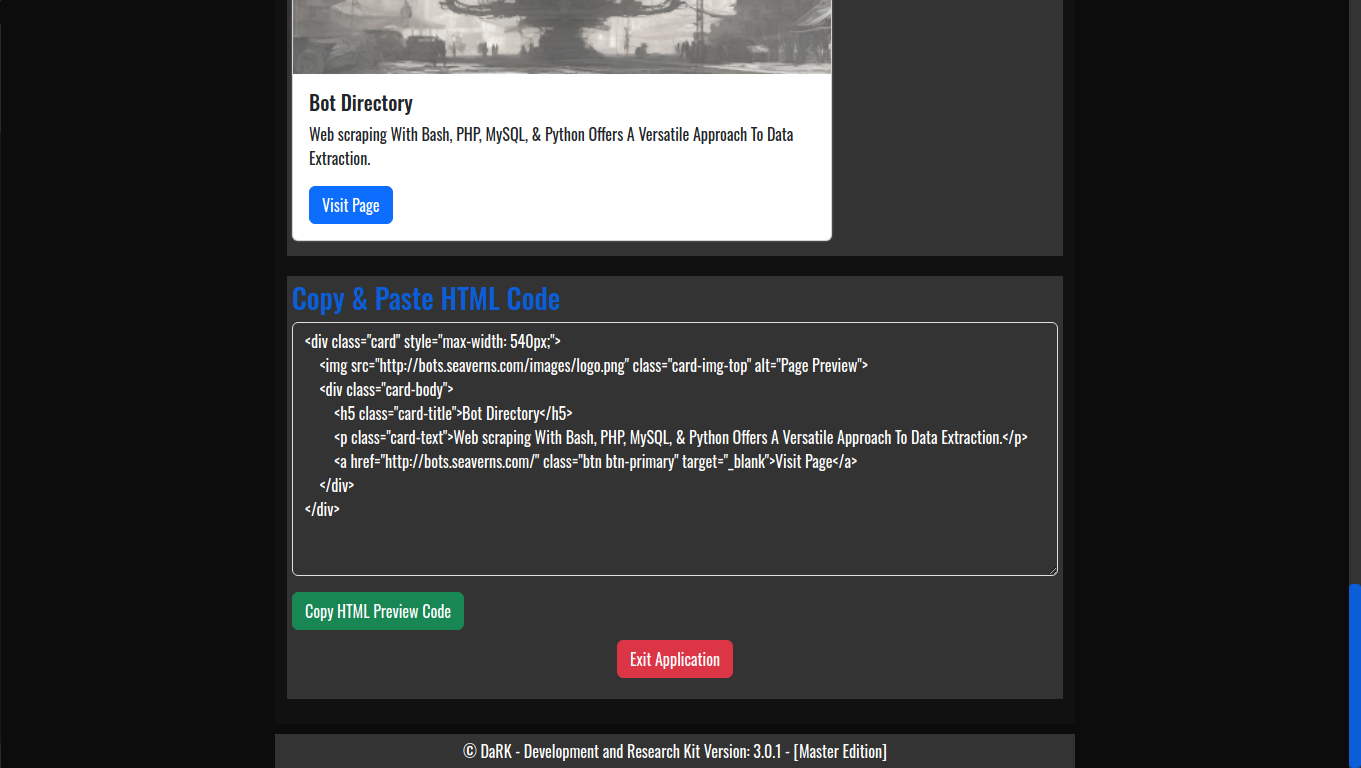
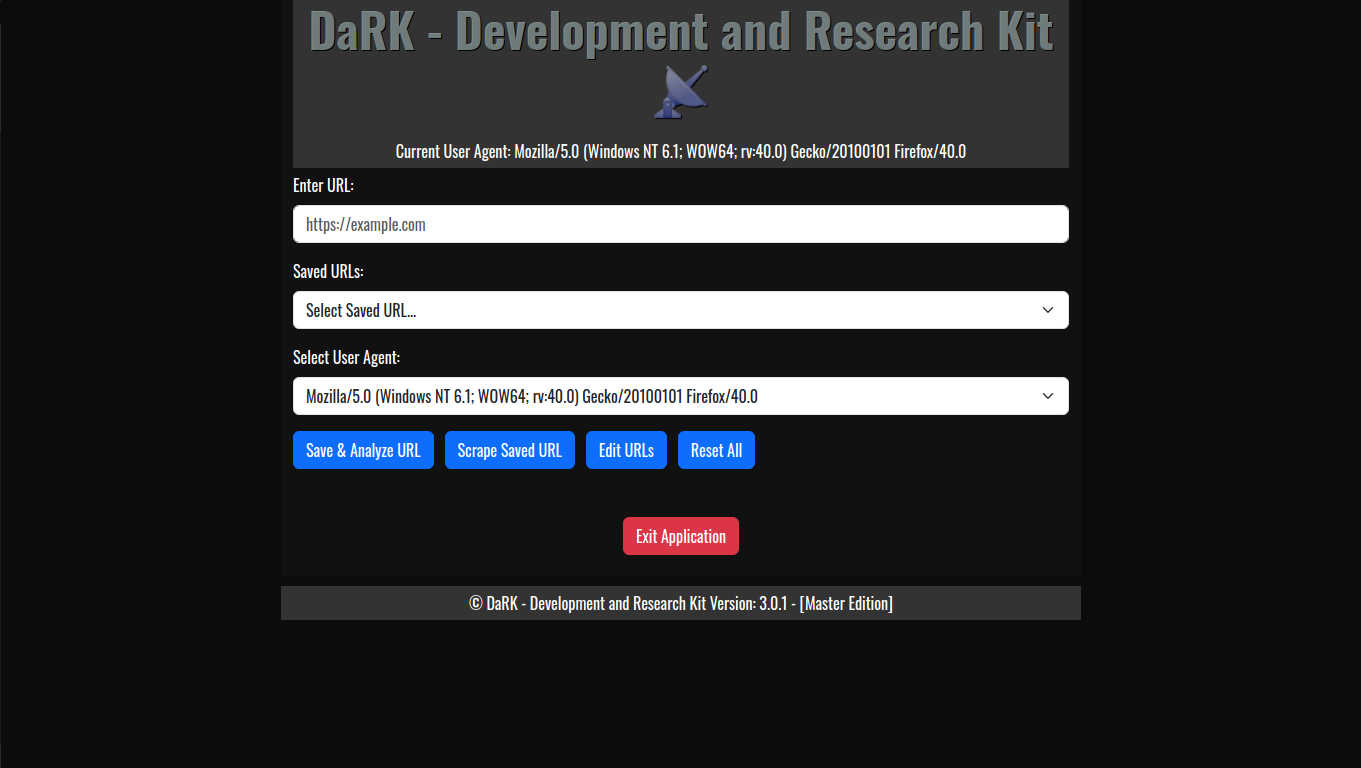
DaRK – Development and Research Kit 3.0 (Master Edition) is an advanced, standalone Python application designed for developers, researchers, and cybersecurity professionals. This tool streamlines the process of web scraping, web page analysis, and HTML code generation, all while integrating features such as anonymous browsing through Tor, automatic user-agent rotation, and a deep scraping mechanism for extracting content from any website.

Key Features and Capabilities

  1. Web Page Analysis:
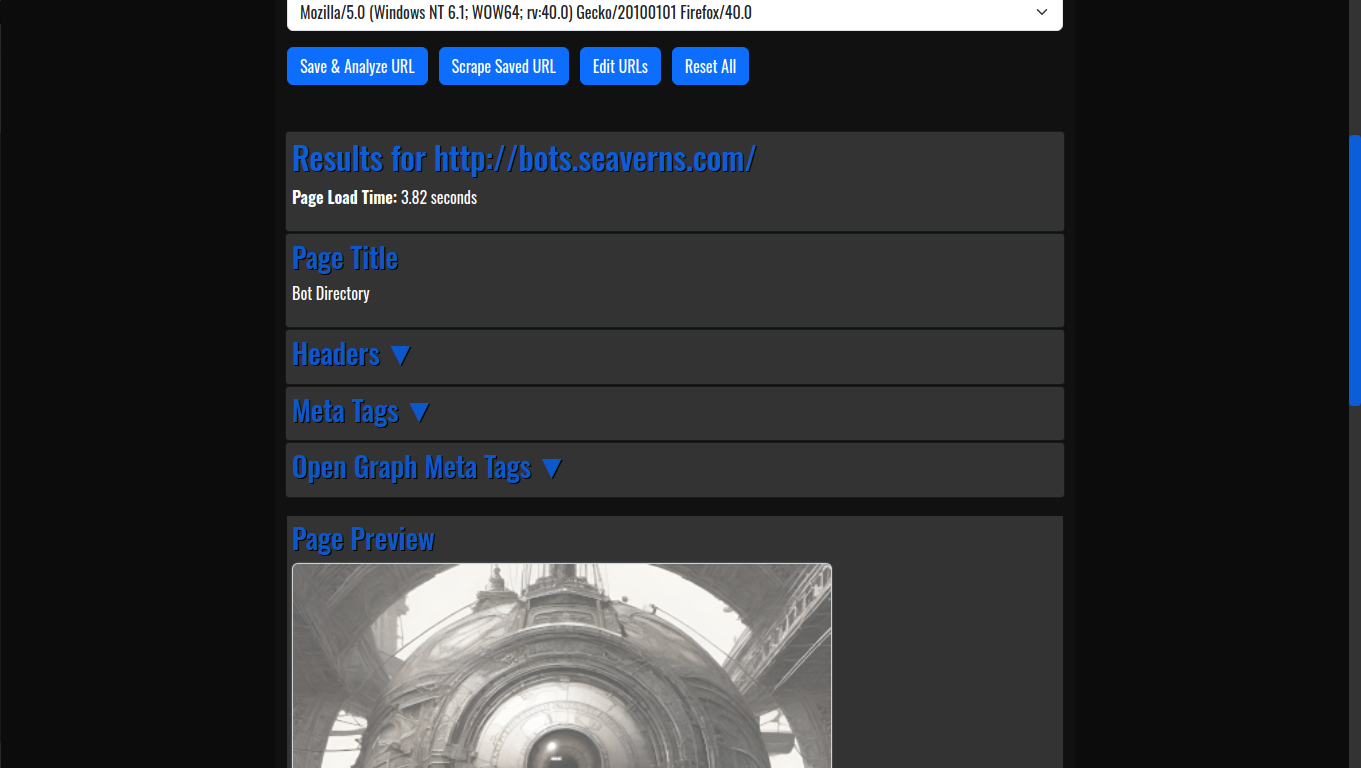
    • HTML Code Previews: The application allows developers to generate live HTML previews of web pages, enabling quick and efficient testing without needing to launch full web browsers or rely on external tools.
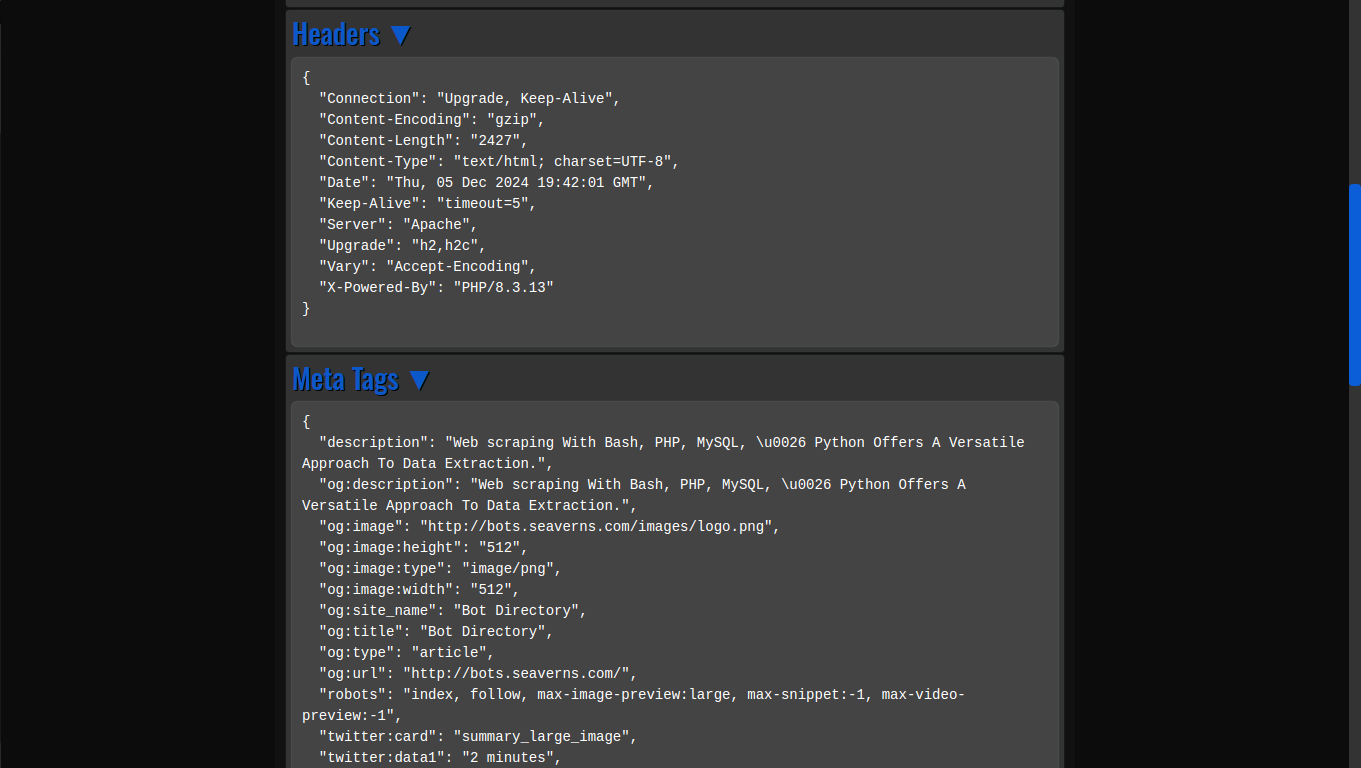
    • View Web Page Headers: By simply entering a URL, users can inspect the HTTP headers returned by the web server, offering insights into server configurations, response times, and more.
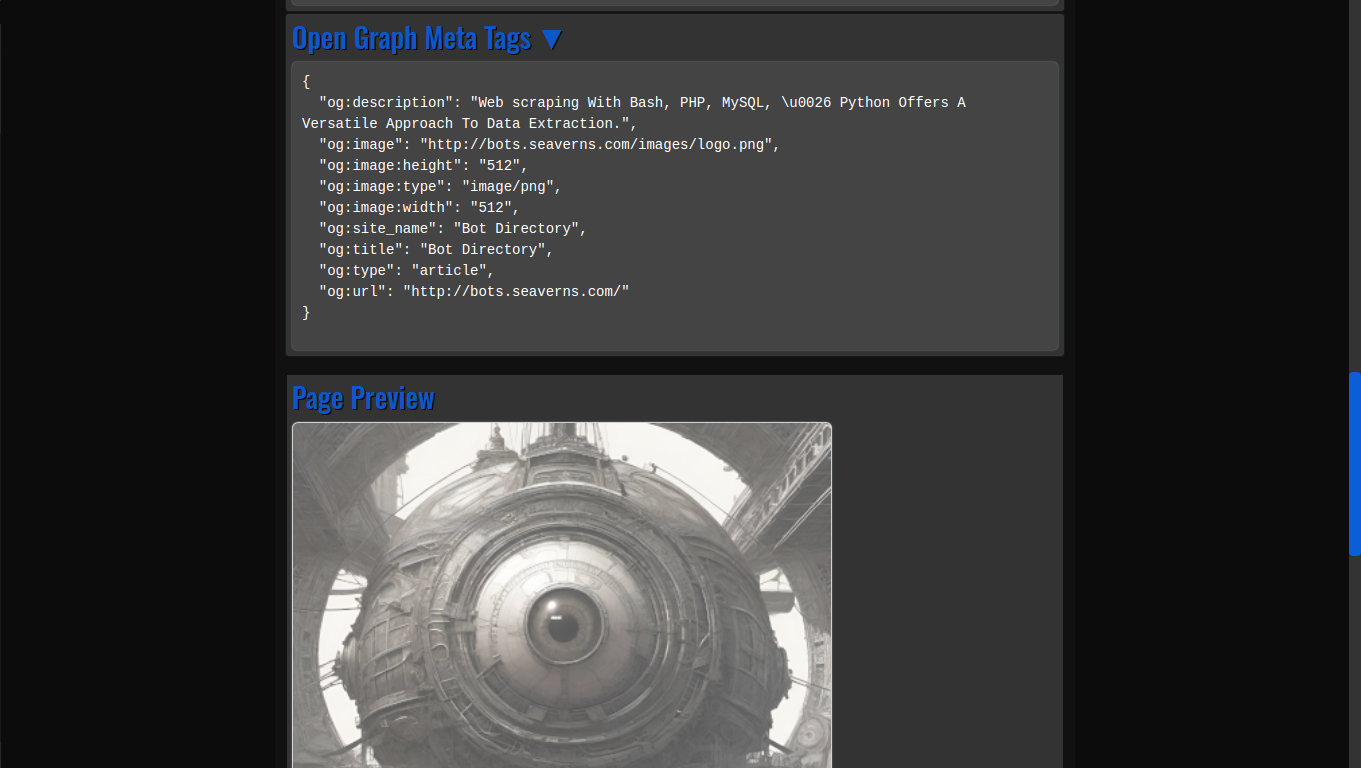
    • Og Meta Tags: Open Graph meta tags, which are crucial for social media previews, are extracted automatically from any URL, providing developers with valuable information about how a webpage will appear when shared on platforms like Facebook and Twitter.
  2. Web Scraping Capabilities:
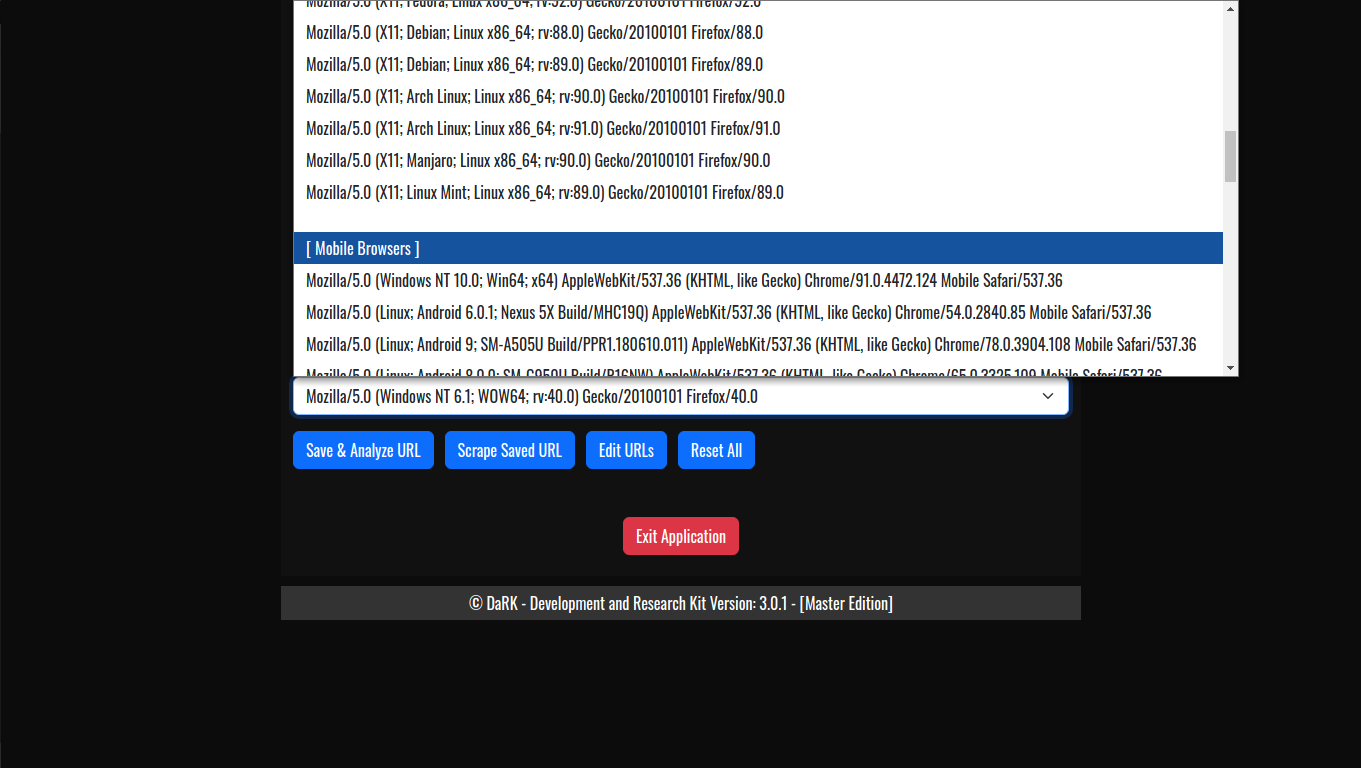
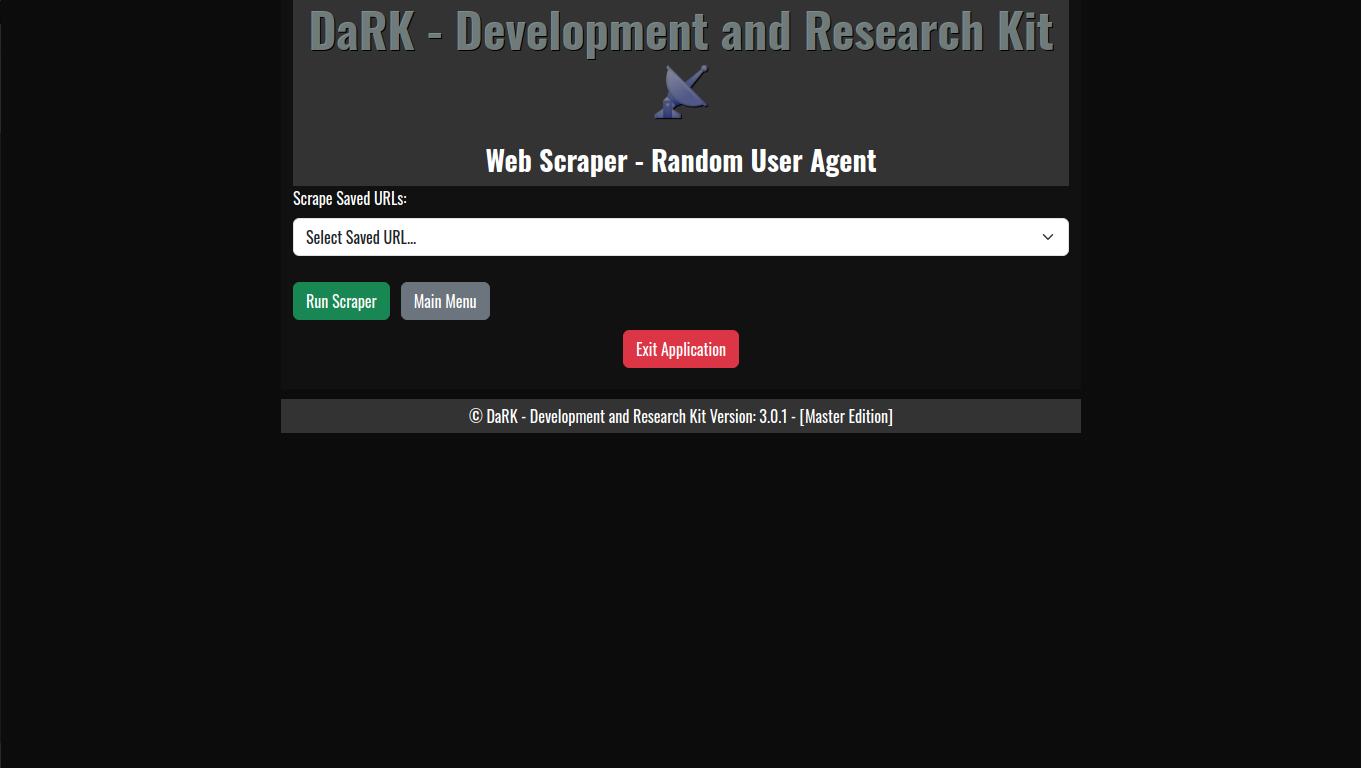
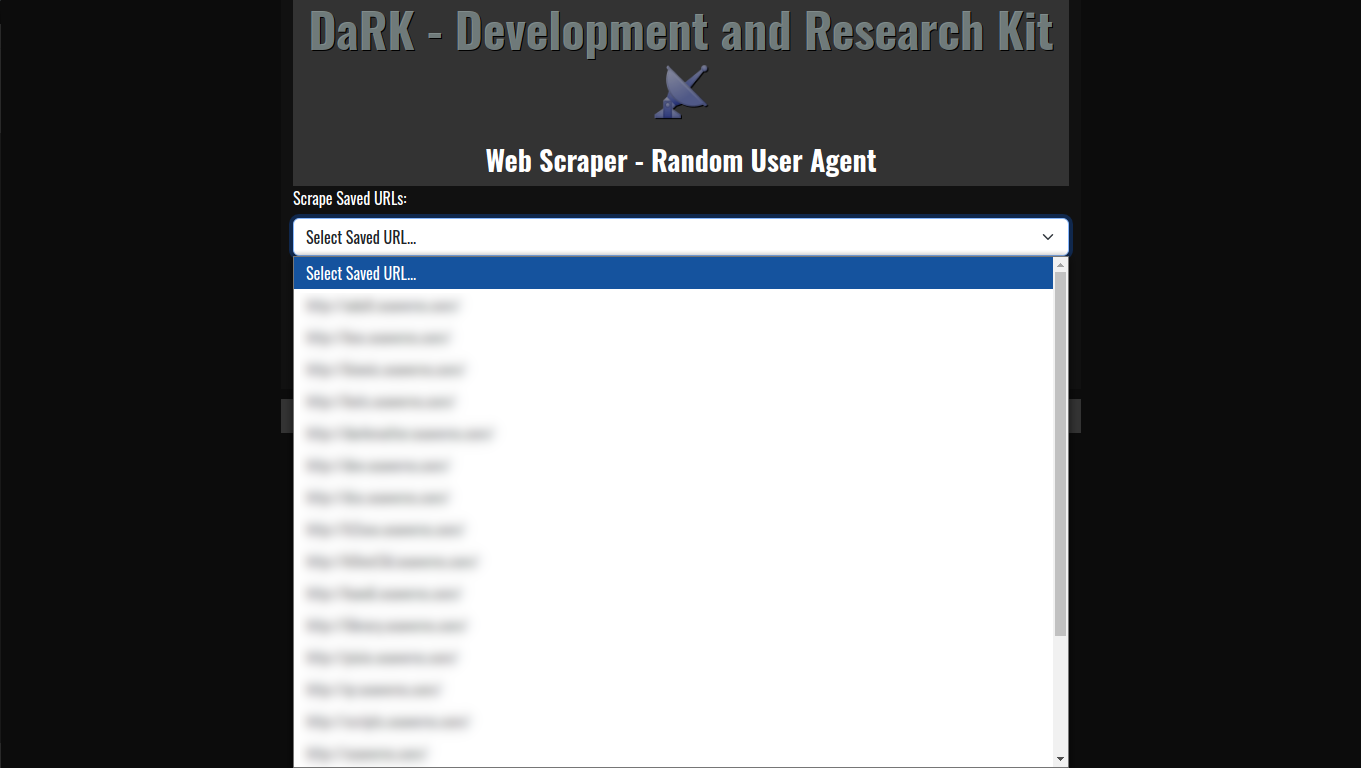
    • Random User-Agent Rotation: The application comes with an extensive list of over 60 user-agents, including popular browsers and bots. This allows for a varied and random selection of user-agent strings for each scraping session, helping to avoid detection and rate-limiting from websites.
    • Deep Scraping: The scraping engine is designed for in-depth content extraction. It is capable of downloading and extracting nearly every file on a website, such as images, JavaScript files, CSS, and documents, making it an essential tool for researchers, web developers, and penetration testers.
  3. Anonymity with Tor:
    • The app routes all HTTP/HTTPS requests through Tor, ensuring anonymity during web scraping and browsing. This is particularly beneficial for scraping data from sites that restrict access based on IP addresses or are behind geo-blocking mechanisms.
    • Tor Integration via torsocks: DaRK leverages the torsocks tool to ensure that all requests made by the application are anonymized, providing an extra layer of privacy for users.
  4. Browser Control:
    • Launch and Close Browser from HTML: Using the Chrome browser, DaRK can launch itself as a web-based application, opening a local instance of the tool’s user interface (UI) in the browser. Once finished, the app automatically closes the browser to conserve system resources, creating a seamless user experience.
  5. SQLite Database for URL Storage:
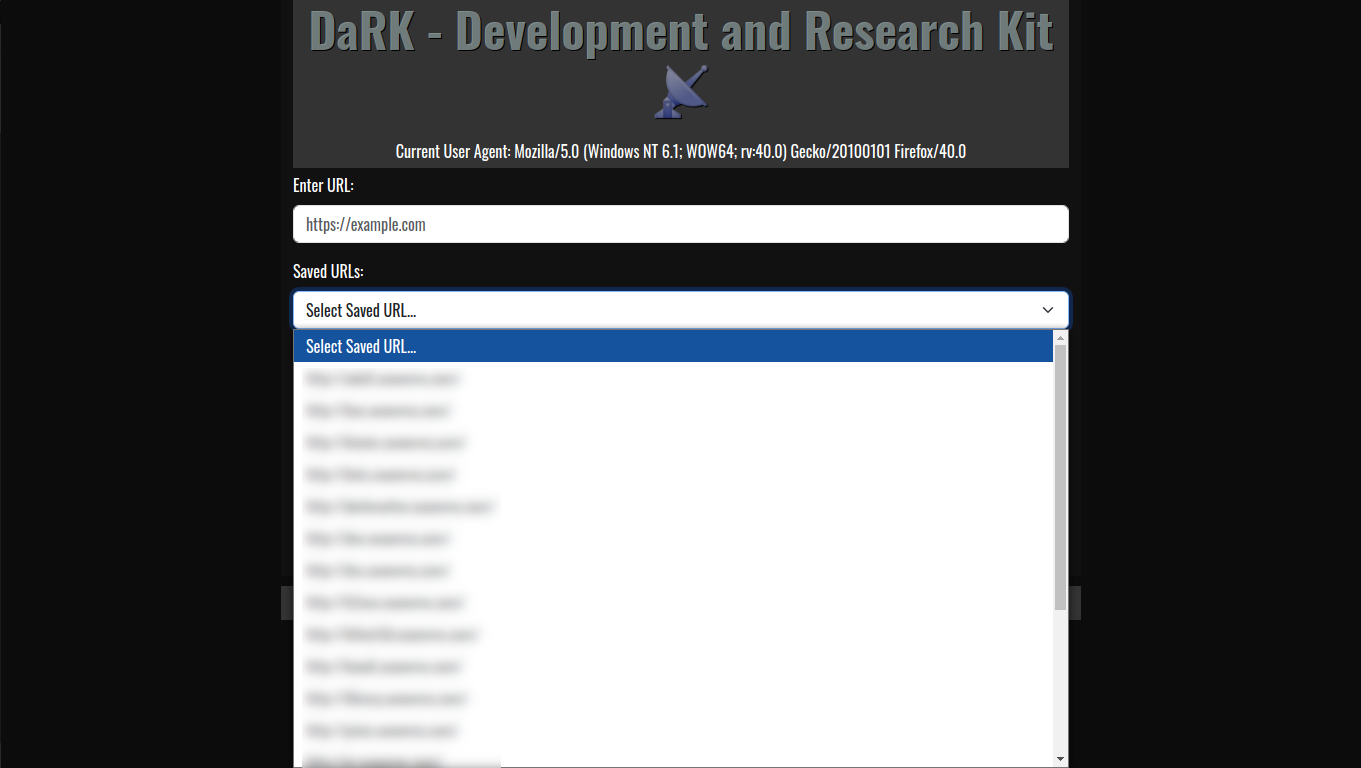
    • Persistent Storage: The tool maintains a local SQLite database where URLs are stored, ensuring that web scraping results can be saved, revisited, and referenced later. The URLs are timestamped, making it easy to track when each site was last accessed.
  6. Flask Web Interface:
    • The application includes a lightweight Flask web server that provides a user-friendly interface for interacting with the app. Users can input URLs, generate previews, and review scraped content all from within a web-based interface.
    • The Flask server runs locally on the user’s machine, ensuring all data stays private and secure.

DaRK Development and Research Kit 3.0 Core Components

  • Tor Integration: The get_tor_session() function configures the requests library to route all traffic through the Tor network using SOCKS5 proxies. This ensures that the user’s browsing and scraping activity remains anonymous.
  • Database Management: The initialize_db() function sets up an SQLite database to store URLs, and save_url() ensures that new URLs are added without duplication. This enables the tool to keep track of visited websites and their metadata.
  • Web Scraping: The scraping process utilizes BeautifulSoup to parse HTML content and extract relevant information from the web pages, such as Og meta tags and headers.
  • Multi-threading: The tool utilizes Python’s Thread and Timer modules to run operations concurrently. This helps in opening the browser while simultaneously executing other tasks, ensuring optimal performance.

Use Case Scenarios

  • Developers: DaRK simplifies the process of generating HTML previews and inspecting headers, making it a valuable tool for web development and testing.
  • Cybersecurity Professionals: The deep scraping feature, along with the random user-agent rotation and Tor integration, makes DaRK an ideal tool for penetration testing and gathering information on potentially malicious or hidden websites.
  • Researchers: DaRK is also an excellent tool for gathering large volumes of data from various websites anonymously, while also ensuring compliance with ethical scraping practices.

DaRK Development and Research Kit 3.0

DaRK – Development and Research Kit 3.0 [Master Edition] is a powerful and versatile tool for anyone needing to interact with the web at a deeper level. From generating HTML previews and inspecting web headers to performing advanced web scraping with enhanced privacy via Tor, DaRK offers an all-in-one solution. The application’s integration with over 60 user agents and its deep scraping capabilities ensure it is both effective and resilient against modern web security mechanisms. Whether you are a developer, researcher, or security professional, DaRK offers the tools you need to work with the web efficiently, securely, and anonymously.

Kandi Web Crawler PHP Web Scraping Scripts Seaverns Web Development Coding Security Applications and Software Development Bex Severus Galleries Digital Art & Photography

Web Scraping Basics

Web Scraping Basics:
Understanding the World of Scrapers

Web scraping basics refer to the fundamental techniques and tools used to extract data from websites. This powerful process enables users to gather large amounts of data automatically from the internet, transforming unstructured content into structured formats for analysis, research, or use in various applications.

At its core, web scraping involves sending an HTTP request to a website, downloading the page, and then parsing the HTML to extract useful information. The extracted data can range from text and images to links and tables. Popular programming languages like Python, along with libraries like BeautifulSoup, Scrapy, and Selenium, are often used to build scrapers that automate this process.

The importance of web scraping basics lies in its ability to collect data from numerous sources efficiently. Businesses, data scientists, marketers, and researchers rely on scraping to gather competitive intelligence, track market trends, scrape product details, and monitor changes across websites.

However, web scraping is not without its challenges. Websites often use anti-scraping technologies like CAPTCHAs, rate-limiting, or IP blocking to prevent unauthorized scraping. To overcome these hurdles, scrapers employ techniques like rotating IPs, using proxies, and simulating human-like browsing behavior to avoid detection.

Understanding the ethical and legal implications of web scraping is equally important. Many websites have terms of service that prohibit scraping, and violating these terms can lead to legal consequences. It’s crucial to always respect website policies and use scraping responsibly.

In conclusion, web scraping basics provide the foundation for harnessing the power of automated data extraction. By mastering the techniques and tools involved, you can unlock valuable insights from vast amounts of online data, all while navigating the challenges and ethical considerations in the world of scrapers.

Web Scraping Basics:
Best Resources for Learning Web Scraping

Web scraping is a popular topic, and there are many excellent resources available for learning. Here are some of the best places where you can find comprehensive and high-quality resources on web scraping:

1. Online Courses

  • Udemy:
    • “Web Scraping with Python” by Andrei Neagoie: Covers Python libraries like BeautifulSoup, Selenium, and requests.
    • “Python Web Scraping” by Jose Portilla: A complete beginner’s guide to web scraping.
  • Coursera:
    • “Data Science and Python for Web Scraping”: This course provides a great mix of Python and web scraping with practical applications.
  • edX:
    • Many universities, like Harvard and MIT, offer courses that include web scraping topics, especially related to data science.

2. Books

  • “Web Scraping with Python” by Ryan Mitchell: This is one of the best books for beginners and intermediates, providing in-depth tutorials using popular libraries like BeautifulSoup, Scrapy, and Selenium.
  • “Python for Data Analysis” by Wes McKinney: Although it’s primarily about data analysis, it includes sections on web scraping using Python.
  • “Automate the Boring Stuff with Python” by Al Sweigart: A beginner-friendly book that includes a great section on web scraping.

3. Websites & Tutorials

  • Real Python:
    • Offers high-quality tutorials on web scraping with Python, including articles on using BeautifulSoup, Scrapy, and Selenium.
  • Scrapy Documentation: Scrapy is one of the most powerful frameworks for web scraping, and its documentation provides a step-by-step guide to getting started.
  • BeautifulSoup Documentation: BeautifulSoup is one of the most widely used libraries, and its documentation has plenty of examples to follow.
  • Python Requests Library: The Requests library is essential for making HTTP requests, and its documentation has clear, concise examples.

4. YouTube Channels

  • Tech with Tim: Offers great beginner tutorials on Python and web scraping.
  • Code Bullet: Focuses on programming projects, including some that involve web scraping.
  • Sentdex: Sentdex has a great web scraping series that covers tools like BeautifulSoup and Selenium.

5. Community Forums

  • Stack Overflow: There’s a large community of web scraping experts here. You can find answers to almost any problem related to web scraping.
  • Reddit – r/webscraping: A community dedicated to web scraping with discussions, tips, and resources.
  • GitHub: There are many open-source web scraping projects on GitHub that you can explore for reference or use.

6. Tools and Libraries

  • BeautifulSoup (Python): One of the most popular libraries for HTML parsing. It’s easy to use and great for beginners.
  • Scrapy (Python): A more advanced, powerful framework for large-scale web scraping. Scrapy is excellent for handling complex scraping tasks.
  • Selenium (Python/JavaScript): Primarily used for automating browsers. Selenium is great for scraping dynamic websites (like those that use JavaScript heavily).
  • Puppeteer (JavaScript): If you’re working in JavaScript, Puppeteer is a great choice for scraping dynamic content.

7. Web Scraping Blogs

  • Scrapinghub Blog: Articles on best practices, tutorials, and new scraping techniques using Scrapy and other tools.
  • Dataquest Blog: Offers tutorials and guides that include web scraping for data science projects.
  • Towards Data Science: This Medium publication regularly features web scraping tutorials with Python and other languages.

8. Legal and Ethical Considerations

  • It’s important to understand the ethical and legal aspects of web scraping. Resources on this topic include:

9. Practice Sites

  • Web Scraper.io: A web scraping tool that also offers tutorials and practice datasets.
  • BeautifulSoup Practice: Hands-on exercises specifically for web scraping.
  • Scrapingbee: Provides an API for scraping websites and a blog with tutorials.

With these resources, you should be able to build a solid foundation in web scraping and advance to more complex tasks as you become more experienced.

BootyBot Adult AI Art Images

The Rise of AI-Generated Spam on Facebook

The Rise of AI-Generated Spam on Facebook: Current Issues and Trends

Over the past few days, Facebook has faced a notable increase in spam activity driven by AI-generated content. These posts, often featuring surreal or hyper-realistic images, are part of a coordinated effort by spammers to exploit the platform’s algorithms for financial gain. Here’s a breakdown of the situation and its implications:


What’s Happening?

  1. AI-Generated Images: Spam pages are flooding Facebook with AI-crafted images, ranging from bizarre art to visually stunning but nonsensical content. A notable example includes viral images of statues made from unusual materials, such as “Jesus made of shrimp”​.
  2. Amplification by Facebook Algorithms: These posts gain traction due to Facebook’s “Suggested for You” feature, which promotes posts based on engagement patterns rather than user preferences. When users interact with these posts—even unintentionally—the algorithm further boosts their visibility​.
  3. Monetary Motives: Many spam pages link to external ad-heavy or dropshipping sites in the comments, monetizing the engagement from these viral posts. Some pages even invest in Facebook ads to amplify their reach, complicating the platform’s efforts to detect and mitigate such content​.
  4. Global Scale: The spam campaigns are widespread, with some pages managing hundreds of millions of interactions collectively. This level of engagement highlights the challenge of moderating such content at scale​.

Facebook’s Response

Meta (Facebook’s parent company) has acknowledged the issue and pledged to improve transparency by labeling AI-generated content. This move comes after similar concerns about misinformation and malicious AI use on the platform. However, critics argue that Facebook’s reliance on automated moderation tools may not be enough to counter the evolving tactics of spammers​.


Broader Implications

  • Erosion of Trust: As AI-generated spam becomes more prevalent, users may find it increasingly difficult to discern authentic content from manipulated posts.
  • Algorithmic Loopholes: The incident underscores the potential vulnerabilities in content recommendation systems, which can inadvertently amplify harmful or deceptive material.
  • Economic and Security Risks: The monetization of these schemes often involves redirecting users to risky sites, posing both financial and cybersecurity threats​.

The current surge in spam ads on Facebook is primarily linked to bot farms and automation tools that exploit the platform for fake engagement. These bots are not only designed to spread irrelevant ads but also to generate fake clicks, skew ad analytics, and disrupt genuine user experiences. Recent incidents indicate that these ad bots are part of larger operations targeting platforms like Facebook, Instagram, and others.

Two categories of bots dominate Facebook spamming:

  1. Automated Bots: These are simpler systems designed to mass-produce accounts and post repetitive ads. Facebook’s AI can often detect and block these quickly, but the sheer volume still creates noise.
  2. Manual or Sophisticated Bots: These accounts mimic real user behavior, making them harder to detect. They are often used for more strategic ad campaigns, spreading disinformation or promoting scams.

Historically, operations like Boostgram and Instant-Fans.com have been known to utilize such bot networks, targeting users with fake engagement across multiple platforms, including Facebook. Meta (Facebook’s parent company) regularly takes legal action against such entities, but many adapt and persist​.

Additionally, bot farms often consist of thousands of fake accounts designed to interact with ads, affecting advertiser metrics and budgets. Facebook reports significant efforts in removing fake accounts, claiming millions blocked quarterly, but challenges remain with sophisticated bots bypassing detection​.

If you’re seeing increased spam, it might be part of a broader effort by these bot operators to exploit Facebook’s ad systems or test new evasion techniques. Users and advertisers are encouraged to report suspicious activity and remain cautious about ad engagement.


Bot farms are large-scale operations leveraging networks of automated programs to execute repetitive digital tasks for malicious purposes. These include manipulating financial markets, inflating ad metrics, and engaging in cyber fraud. Bot farms often consist of numerous servers, diverse IP address pools, and highly advanced scripts to evade detection, allowing them to operate at scale and with precision.

In financial markets, bots can exacerbate volatility by executing coordinated trades, such as artificial inflation schemes (pump-and-dump) or high-frequency trades to disrupt normal market behavior. These actions mislead investors, distort pricing mechanisms, and can destabilize entire markets, especially during periods of economic uncertainty. Such disruptions are not limited to legitimate trading but also extend to platforms reliant on algorithmic responses, creating widespread ripple effects.

Economically, these bot-driven disruptions cause substantial financial losses, costing industries billions annually. For example, fraudulent advertising metrics waste business resources while masking true engagement. High-profile operations like Methbot exploited hundreds of thousands of fake IP addresses, generating fraudulent ad revenue on a massive scale and undermining trust in digital advertising ecosystems.

Efforts to mitigate the impact of bot farms include deploying machine learning models to identify anomalous behavior, monitoring for IP spoofing, and implementing stronger authentication methods. However, as bot technology continues to evolve, combating their influence requires ongoing innovation, stricter regulations, and global collaboration to protect financial and digital ecosystems from systemic risks.


Current Events and Developments

  1. Meta’s AI Transparency Push: Meta has committed to labeling AI-generated images across its platforms, aiming to curtail the spread of manipulated content and improve user awareness​.
  2. Increased Monitoring Efforts: Researchers and watchdogs are ramping up analyses of such campaigns. For instance, studies by Stanford and Georgetown have documented hundreds of spam pages exploiting Facebook’s engagement-driven algorithms​.
  3. User Awareness Campaigns: Public advisories are being issued, encouraging users to avoid interacting with suspicious posts and report them to Facebook for moderation.

What You Can Do

  • Avoid Interactions: Refrain from liking, commenting, or sharing suspicious content.
  • Report Spam: Use Facebook’s reporting tools to flag AI-generated spam posts.
  • Stay Informed: Regularly update your knowledge of online scams and be cautious of external links, especially those posted in comments.

By understanding the tactics and implications of these campaigns, users can help reduce their impact while pushing platforms like Facebook to strengthen their moderation policies.

Seaverns Web Development Coding Security Applications and Software Development Bex Severus Galleries Digital Art & Photography

BotNets Technology Hacking Automation Scripts

Part 1: BotNets – What Are They and What Is Their Purpose?

What Are Botnets?

A botnet is a network of compromised computers or devices, known as “bots” or “zombies,” which are controlled remotely by an attacker, often referred to as a “botmaster” or “bot herder.” These botnets can be used to perform a variety of malicious activities, typically without the knowledge of the device owners.

Evolution of Botnets

  1. Early Days:
    • IRC-Based Botnets (1990s): The earliest botnets used Internet Relay Chat (IRC) to command infected machines. These bots were often created for fun or minor pranks but set the stage for more serious threats.
    • Example: The “Sub 7” and “Back Orifice” trojans were among the first to create such networks.
  2. 2000s – Rise of Complexity:
    • Peer-to-Peer (P2P) Networks: Botnets evolved to use P2P networks to avoid centralized control and improve resilience.
    • Example: The “Storm Worm” utilized a P2P architecture to distribute commands.
  3. 2010s – Advanced Botnets:
    • Botnets as a Service: The commercialization of botnets turned them into a service for hire.
    • Example: The “Mirai” botnet, which primarily targeted IoT devices, became infamous for its scale and impact.
  4. 2020s – Sophisticated and Distributed Attacks:
    • Targeted Attacks and Cryptojacking: Modern botnets often focus on specific targets or exploit devices for cryptojacking.
    • Example: “Emotet” and “TrickBot” are known for their sophisticated modularity and targeted attacks.

Common Uses of Botnets

  1. Distributed Denial of Service (DDoS) Attacks:
    • Overwhelm a target server or network with traffic to make it inaccessible.
  2. Spam and Phishing:
    • Distribute large volumes of spam emails or phishing attempts to harvest personal information.
  3. Data Theft:
    • Steal sensitive information from compromised systems.
  4. Cryptojacking:
    • Utilize infected devices to mine cryptocurrency without the user’s consent.
  5. Click Fraud:
    • Automate clicks on online ads to generate fraudulent revenue.

Key Terminology

  • Botmaster/Bot Herder: The individual who controls the botnet.
  • Command and Control (C2): The server or infrastructure used to send commands to the bots.
  • Infection Vector: The method by which the botnet malware is spread (e.g., phishing, exploit kits).
  • Zombies/Bots: Infected devices within the botnet.

Popular Variants

  1. Mirai:
    • Known for its large-scale attacks using IoT devices.
    • Exploits default passwords on IoT devices.
  2. Emotet:
    • Initially a banking trojan, evolved into a modular botnet used for a variety of malicious activities.
    • Known for its resilience and ability to distribute other malware.
  3. Zeus/Zbot:
    • A banking trojan that evolved into a powerful botnet for stealing financial credentials.
  4. Conficker:
    • One of the largest and most infamous botnets, known for its ability to spread through vulnerabilities in Windows operating systems.

Part 2: A Basic Example of a Botnet

Overview

Let’s look at a simple Python script example to demonstrate the concept of a botnet. This example is for educational purposes only and should not be used for any malicious activities.

Basic Botnet Example in Python

# Example BotNet In Python:

import socket
import threading

# This is the bot (client) code.

def connect_to_server():
    server_ip = "127.0.0.1"  # IP of the command and control server (for demonstration)
    server_port = 12345      # Port of the command and control server

    s = socket.socket(socket.AF_INET, socket.SOCK_STREAM)
    try:
        s.connect((server_ip, server_port))
        print("Connected to server")
        
        while True:
            command = s.recv(1024).decode('utf-8')
            if command == "shutdown":
                print("Shutting down...")
                break
            else:
                # Execute command
                print(f"Received command: {command}")
                # For security reasons, this part is left out in this example.
                # You could use os.system(command) to execute commands.
        
    except Exception as e:
        print(f"Error: {e}")
    finally:
        s.close()

def main():
    # Create multiple threads to simulate multiple bots
    for i in range(5):  # Simulating 5 bots
        t = threading.Thread(target=connect_to_server)
        t.start()

if __name__ == "__main__":
    main()

Explanation

  1. Socket Setup:
    • The socket library is used to create a network connection. The bot connects to a predefined IP address and port number of the command and control (C2) server.
  2. Connection Handling:
    • The connect_to_server() function establishes a connection to the C2 server and listens for commands.
  3. Command Execution:
    • The bot waits for commands from the C2 server. If it receives a command (e.g., “shutdown”), it performs the action. In a real-world scenario, commands could be anything, including executing system commands or sending data.
  4. Multithreading:
    • Multiple threads are created to simulate multiple bots connecting to the C2 server concurrently. Each thread represents an individual bot.
  5. Error Handling:
    • Basic error handling is in place to catch and display any exceptions that occur during the connection or execution process.

Note

This example demonstrates a simplified version of a botnet client. In real-world scenarios, botnets are more complex and include additional features such as encryption, obfuscation, and advanced command structures. This script is provided for educational purposes to understand the basic principles of how botnets operate.

Related Links:
Home Network Router Attacks
BotNet Archive – For Educational Purposes Only!

Kali Linux Wallpapers Full Screen Images High Quality Desktop, Laptop, Android Wallpaper.

The Modern Day Warrior: Integrating Sun Tzu’s Wisdom with Contemporary Hacking Techniques

The Modern Day Warrior: Integrating Sun Tzu’s Wisdom with Contemporary Hacking Techniques

In today’s digital landscape, the art of hacking mirrors the ancient strategies of warfare articulated by Sun Tzu in The Art of War. Just as Sun Tzu’s teachings have guided military leaders through centuries, they also offer profound insights for understanding and mastering modern hacking techniques. This article explores how Sun Tzu’s principles can be applied to the realm of contemporary hacking, turning today’s hackers into modern-day warriors.

Understanding the Battlefield: Digital Terrain

Sun Tzu’s Insight:

“Know your enemy and know yourself and you can fight a hundred battles without disaster.”

Contemporary Application: In the world of hacking, understanding the digital landscape—your “terrain”—is crucial. This includes knowledge of network architecture, software vulnerabilities, and organizational security practices. Hackers, like warriors, must thoroughly research their target systems to identify weaknesses and opportunities. This involves understanding the technology stack, potential entry points, and existing defenses.

Strategy and Planning: Preparation is Key

Sun Tzu’s Insight:

“The skillful fighter puts himself into a position which makes defeat impossible, and does not miss the moment for defeating the enemy.”

Contemporary Application: Successful hackers meticulously plan their attacks, leveraging reconnaissance to gather as much information as possible before striking. This phase involves social engineering, scanning for vulnerabilities, and mapping the target’s digital infrastructure. By preparing thoroughly, hackers can position themselves to exploit weaknesses effectively and avoid detection.

Deception and Misdirection: The Art of Distracting the Enemy

Sun Tzu’s Insight:

“All warfare is based on deception. Hence, when we are able to attack, we must seem unable; when using our forces, we must appear inactive; when we are near, we must make the enemy believe we are far away; when far away, we must make him believe we are near.”

Contemporary Application: In hacking, deception is a critical tactic. This can involve creating false trails, using fake identities, or employing misleading tactics to divert attention from the true objectives. Techniques such as phishing, where attackers disguise themselves as trustworthy entities, and planting decoy malware to mislead security teams, exemplify this principle.

Exploiting Weaknesses: Precision Strikes

Sun Tzu’s Insight:

“Attack him where he is unprepared, appear where you are not expected.”

Contemporary Application: Effective hackers identify and exploit the most vulnerable points in a system. This might involve targeting outdated software, poorly configured systems, or unpatched security holes. Precision strikes, where hackers focus on high-value targets or critical weaknesses, can lead to successful breaches with minimal effort.

Adaptability: Flexibility in Tactics

Sun Tzu’s Insight:

“Be extremely subtle, even to the point of formlessness. Be extremely mysterious, even to the point of soundlessness.”

Contemporary Application: The ability to adapt to changing conditions is crucial in hacking. Modern-day hackers must remain flexible, adjusting their tactics based on the responses and countermeasures of their targets. This could mean changing attack vectors, using new exploits, or modifying techniques in real-time to evade detection and maintain access.

Psychological Warfare: Manipulating Perceptions

Sun Tzu’s Insight:

“The greatest victory is that which requires no battle.”

Contemporary Application: Psychological manipulation is a powerful tool in hacking. By creating confusion, spreading misinformation, or exploiting human psychology, hackers can achieve their objectives without direct confrontation. Social engineering, such as convincing employees to divulge sensitive information, and leveraging psychological pressure to force compliance, illustrate the power of psychological tactics.

Defending Against Attack: Lessons in Countermeasures

Sun Tzu’s Insight:

“If you know the enemy and know yourself, you need not fear the result of a hundred battles.”

Contemporary Application: For defenders, understanding hacking tactics and techniques is as important as knowing one’s own system. This involves implementing robust security measures, continuously monitoring for threats, and staying informed about emerging vulnerabilities and attack methods. Regular security audits, employee training, and incident response planning are essential to defend against sophisticated attacks.

Conclusion: The Modern Warrior’s Path

In the digital age, hackers embody the role of the modern-day warrior, applying ancient principles of strategy and deception to navigate the complexities of cyberspace. By integrating Sun Tzu’s timeless wisdom with contemporary hacking techniques, they exemplify the fusion of historical strategy with modern technology.

Whether as attackers or defenders, understanding these principles can enhance strategic thinking and operational effectiveness. For hackers, mastering the art of modern warfare requires not only technical skills but also a deep appreciation of strategic foresight, adaptability, and psychological acumen. For defenders, embracing these lessons offers a path to stronger security and greater resilience against the evolving threats of the digital realm.

Russian Hackers Breach Microsoft.

Russian Hackers breached Microsoft to find out what Microsoft knows about them..

Maybe Microsoft should use Linux?

Original Article: TechCrunch

Wouldn’t you want to know what tech giants know about you?
That’s exactly what Russian government hackers want, too.

On Friday, Microsoft disclosed that the hacking group it calls Midnight Blizzard, also known as APT29 or Cozy Bear — and widely believed to be sponsored by the Russian government — hacked some corporate email accounts, including those of the company’s “senior leadership team and employees in our cybersecurity, legal, and other functions.”

PhP Header Request Spoofing Ip Address User Agent Geo-Location

Russian Hackers Hack Microsoft

Curiously, the hackers didn’t go after customer data or the traditional corporate information they may have normally gone after. They wanted to know more about themselves, or more specifically, they wanted to know what Microsoft knows about them, according to the company.

“The investigation indicates they were initially targeting email accounts for information related to Midnight Blizzard itself,” the company wrote in a blog post and SEC disclosure.

According to Microsoft, the hackers used a “password spray attack” — essentially brute forcing — against a legacy account, then used that account’s permissions “to access a very small percentage of Microsoft corporate email accounts.”

Microsoft did not disclose how many email accounts were breached, nor exactly what information the hackers accessed or stole.

Company spokespeople did not immediately respond to a request for comment.

Microsoft took advantage of news of this hack to talk about how they are going to move forward to make itself more secure.

Clowns do clownish stuff because they're clowns and that's just what clowns do.

“For Microsoft, this incident has highlighted the urgent need to move even faster. We will act immediately to apply our current security standards to Microsoft-owned legacy systems and internal business processes, even when these changes might cause disruption to existing business processes,” the company wrote. “This will likely cause some level of disruption while we adapt to this new reality, but this is a necessary step, and only the first of several we will be taking to embrace this philosophy.”

APT29, or Cozy Bear, is widely believed to be a Russian hacking group working responsible for a series of high-profile attacks, such as those against SolarWinds in 2019, the Democratic National Committee in 2015, and many more.

The Clown Show Must Go On!

Cybercriminals Weaponizing Open-Source SSH-Snake Tool for Network Attacks

SSH-Snake, a self-modifying worm that leverages SSH credentials.

Original Article : The Hacker News

A recently open-sourced network mapping tool called SSH-Snake has been repurposed by threat actors to conduct malicious activities.

“SSH-Snake is a self-modifying worm that leverages SSH credentials discovered on a compromised system to start spreading itself throughout the network,” Sysdig researcher Miguel Hernández said.

“The worm automatically searches through known credential locations and shell history files to determine its next move.”

SSH-Snake was first released on GitHub in early January 2024, and is described by its developer as a “powerful tool” to carry out automatic network traversal using SSH private keys discovered on systems.

In doing so, it creates a comprehensive map of a network and its dependencies, helping determine the extent to which a network can be compromised using SSH and SSH private keys starting from a particular host. It also supports resolution of domains which have multiple IPv4 addresses.

“It’s completely self-replicating and self-propagating – and completely fileless,” according to the project’s description. “In many ways, SSH-Snake is actually a worm: It replicates itself and spreads itself from one system to another as far as it can.”

BotNet CNC Control Hacker Inflitration Exploits Vulnerabilities SSH TCP Bots Hardware Software Exploited

BotNet CNC Control Hacker Infiltrates & Exploits Vulnerabilities Vie SSH TCP Both Hardware Software Exploited

Sysdig said the shell script not only facilitates lateral movement, but also provides additional stealth and flexibility than other typical SSH worms.

The cloud security company said it observed threat actors deploying SSH-Snake in real-world attacks to harvest credentials, the IP addresses of the targets, and the bash command history following the discovery of a command-and-control (C2) server hosting the data.

How Does It Work?

These attacks involve active exploitation of known security vulnerabilities in Apache ActiveMQ and Atlassian Confluence instances in order to gain initial access and deploy SSH-Snake.
“The usage of SSH keys is a recommended practice that SSH-Snake tries to take advantage of in order to spread,” Hernández said. “It is smarter and more reliable which will allow threat actors to reach farther into a network once they gain a foothold.”

When reached for comment, Joshua Rogers, the developer of SSH-Snake, told The Hacker News that the tool offers legitimate system owners a way to identify weaknesses in their infrastructure before attackers do, urging companies to use SSH-Snake to “discover the attack paths that exist – and fix them.”

“It seems to be commonly believed that cyber terrorism ‘just happens’ all of a sudden to systems, which solely requires a reactive approach to security,” Rogers said. “Instead, in my experience, systems should be designed and maintained with comprehensive security measures.”

Netcat file transfer chat utility send receive files

Netcat file transfer chat utility. Easily Send & Receive Files Local & Remote.

“If a cyber terrorist is able to run SSH-Snake on your infrastructure and access thousands of servers, focus should be put on the people that are in charge of the infrastructure, with a goal of revitalizing the infrastructure such that the compromise of a single host can’t be replicated across thousands of others.”

Rogers also called attention to the “negligent operations” by companies that design and implement insecure infrastructure, which can be easily taken over by a simple shell script.

“If systems were designed and maintained in a sane manner and system owners/companies actually cared about security, the fallout from such a script being executed would be minimized – as well as if the actions taken by SSH-Snake were manually performed by an attacker,” Rogers added.

“Instead of reading privacy policies and performing data entry, security teams of companies worried about this type of script taking over their entire infrastructure should be performing total re-architecture of their systems by trained security specialists – not those that created the architecture in the first place.”

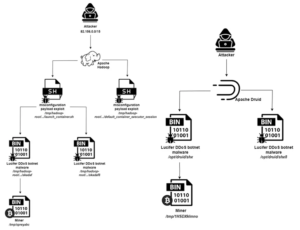
The disclosure comes as Aqua uncovered a new botnet campaign named Lucifer that exploits misconfigurations and existing flaws in Apache Hadoop and Apache Druid to corral them into a network for mining cryptocurrency and staging distributed denial-of-service (DDoS) attacks.

The hybrid cryptojacking malware was first documented by Palo Alto Networks Unit 42 in June 2020, calling attention to its ability to exploit known security flaws to compromise Windows endpoints.
As many as 3,000 distinct attacks aimed at the Apache big data stack have been detected over the past month, the cloud security firm said. This also comprises those that single out susceptible Apache Flink instances to deploy miners and rootkits.

“The attacker implements the attack by exploiting existing misconfigurations and vulnerabilities in those services,” security researcher Nitzan Yaakov said.

Apache Vulnerability Update Available!

Apache Vulnerability Update Available!

“Apache open-source solutions are widely used by many users and contributors. Attackers may view this extensive use as an opportunity to have inexhaustible resources for implementing their attacks on them.”

Russian Hackers Have Infiltrated U.S. Household and Small Business Routers

Hacker News:
Russian Hackers Have Infiltrated U.S. Household and Small Business Routers, FBI Warns
Original Article: MSN News

The FBI has recently thwarted a large-scale cyberattack orchestrated by Russian operatives, targeting hundreds of routers in home offices and small businesses, including those in the United States.

These compromised routers were used to form “botnets”, which were then employed in cyber operations worldwide.

The United States Department of Justice has attributed this cyberattack to the Russian GRU Military Unit 26165. Countermeasures undertaken by authorities ensured that the GRU operators were expelled from the routers and denied further access, ABC News reported.

The GRU deployed a specialized malware called “Moobot,” associated with a known criminal group, to seize control of susceptible home and small office routers, converting them into “botnets” — a network of remotely controlled systems.

The Justice Department, in an official statement, explained, “Non-GRU cybercriminals installed the Moobot malware on Ubiquiti Edge OS routers that still used publicly known default administrator passwords. GRU hackers then used the Moobot malware to install their own bespoke scripts and files that repurposed the botnet, turning it into a global cyber espionage platform.”

Utilizing this botnet, Russian hackers engaged in various illicit activities, including extensive “spearphishing” campaigns and credential harvesting campaigns against targets of intelligence interest to the Russian government, such as governmental, military, security and corporate entities in the United States and abroad.

Botnets pose a significant challenge for intelligence agencies, hindering their ability to detect foreign intrusions into their computer networks, Reuters notes.

In January 2024, the FBI executed a court-approved operation dubbed “Operation Dying Ember” to disrupt the hacking campaign. According to the Department of Justice, the FBI employed malware to copy and erase the malicious data from the routers, restoring full access to the owners while preventing further unauthorized access by GRU hackers.

FEDOR was designed as an android able to replace humans in high-risk areas, such as rescue operations,” Andrey Grigoriev, director of Russia's Advanced Research Fund, said.

FEDOR was designed as an android able to replace humans in high-risk areas, such as rescue operations,” Andrey Grigoriev, director of Russia’s Advanced Research Fund, said.

DSX "Pure SEO" Content Management System

DSX DS7-1.2.5 Content Management System

DSX Version 7-1.2.5 (DS7) “Pure SEO” Content Management System. (Release Update V7-1.2.5)

While this CMS is considered “Black Hat”, it is what it is and it works.
Search Engines have priorities in what ranks and what doesn’t rank and
the single most important things anyone who wants the Top Ten knows are,
that your pages have to load fast, your content has to be abundant, thick and most
of all Hypertext Links.

DSX Delivers on all aspects of Fast Ranking “Pure SEO” tactics that I’ve developed
over the last 20+ years as a Professional SEO Expert and I stand behind my work.
I’m offering DSX 7-1.2.5 at a Very affordable price because it’s very small at this
point and that makes it relatively easy for you to make more of it or if you’re patient,
wait for the next version with far more features.

Installation & Troubleshooting.
View Demo