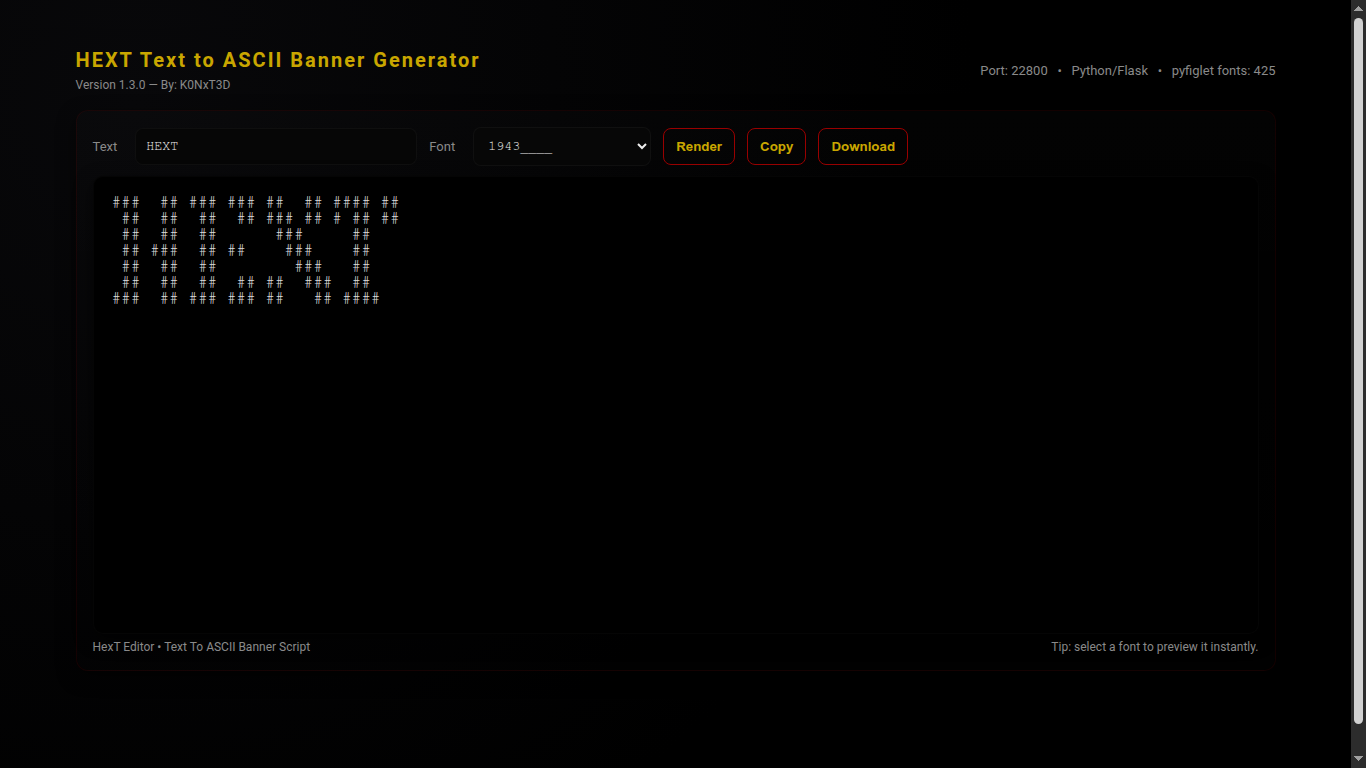
HEXT 2.0 Text to ASCII Banner Generator is a Python3 web application that converts text into ASCII banners using pyfiglet.
It features a modern, dark aesthetic interface with live font selection, copy and download functionality, and full-screen previews.
- Type text into the input field
- Select a font from the dropdown
- Click "Render"
4) Copy / Download
- Click "Copy" to clipboard
- Click "Download" to save .txt file
License
MIT License

Copyright (c) 2025 Rob Seaverns

Permission is hereby granted, free of charge, to any person obtaining a copy
of this software and associated documentation files (the “Software”), to deal
in the Software without restriction, including without limitation the rights
to use, copy, modify, merge, publish, distribute, sublicense, and/or sell
copies of the Software, and to permit persons to whom the Software is
furnished to do so, subject to the following conditions:

The above copyright notice and this permission notice shall be included in
all copies or substantial portions of the Software.

THE SOFTWARE IS PROVIDED “AS IS”, WITHOUT WARRANTY OF ANY KIND, EXPRESS OR
IMPLIED, INCLUDING BUT NOT LIMITED TO THE WARRANTIES OF MERCHANTABILITY,
FITNESS FOR A PARTICULAR PURPOSE AND NONINFRINGEMENT. IN NO EVENT SHALL THE
AUTHORS OR COPYRIGHT HOLDERS BE LIABLE FOR ANY CLAIM, DAMAGES OR OTHER
LIABILITY, WHETHER IN AN ACTION OF CONTRACT, TORT OR OTHERWISE, ARISING
FROM, OUT OF OR IN CONNECTION WITH THE SOFTWARE OR THE USE OR OTHER
DEALINGS IN THE SOFTWARE.
Directory Reconnaissance System — Version 2.1.0 · K0NxT3D
VoidCrawler File Reconnaissanceis 2.0.1 is a DaRK-themed, tactical directory intelligence system built for precision, stealth, and control.
It recursively scans a base folder, renders a collapsible directory tree, and exposes direct-download links while filtering common web-app clutter.
VoidCrawler works exceptionally well with many DaRK Utilities.
Overview
VoidCrawler is designed as a reconnaissance tool rather than a general-purpose file manager. It strips noise, surfaces operational files, and presents a minimal, militarized UI ideal for server ops, forensic mapping, and admin dashboards.
Key Capabilities
Recursive directory mapping with natural sort
Collapsible folder UI (Bootstrap-powered)
Dedicated top-level “Direct Downloads” console
Filters out .htaccess, *.php, *.html, *.db, *.png
Pure PHP — no heavy frameworks required
History
VoidCrawler was not built to politely index.
It was not built to tag, catalog, or maintain compliance.
VoidCrawler was designed to invade.
To descend into dark directories.
To crawl the void between folders where broken paths hitchhike and dead files linger.
Installation
Create a folder on your server for VoidCrawler (example: /var/www/html/voidcrawler).
Drop the VoidCrawler PHP file (index.php) into that folder.
Ensure the webserver user has read permissions: chmod -R 755 /var/www/html/voidcrawler
Open the folder in a browser: https://yourdomain.com/voidcrawler/
Note: VoidCrawler reads directories only. It performs no writes, no command execution, and makes no remote API calls.
Quick Usage
The script scans from the directory it lives in by default. To change start path, edit the $root variable in the PHP file.
At its core, VoidCrawler uses a recursive function to enumerate entries, separate directories and allowed files, sort them naturally, and render them into two main UI blocks:
Directories: a collapsible list on the left
Direct Downloads: top-level file console for quick retrieval
Core recursive logic (excerpt)
function myScanDir($dir, $level, $rootLen)
{
    global $pathLen;

    if ($handle = opendir($dir)) {
        $allFiles = [];

        while (false !== ($entry = readdir($handle))) {
            if ($entry != "." && $entry != ".." && $entry != ".htaccess") {
                if (is_dir($dir . "/" . $entry)) {
                    $allFiles[] = "D: " . $dir . "/" . $entry;
                } else if (!in_array(strtolower(pathinfo($entry, PATHINFO_EXTENSION)), ['php', 'html', 'db', 'png'])) {
                    $allFiles[] = "F: " . $dir . "/" . $entry;
                }
            }
        }

        closedir($handle);
        natsort($allFiles);

        // ...output folders and files with collapse UI...
    }
}
Configuration
Excluded Extensions
Default filter list (edit in the script):
['php', 'html', 'db', 'png']
Path
Set the scanning root in the PHP file. Use absolute paths when moving outside webroot. Example:
$root = '/var/www/html/wp-content/uploads/';
Security & Deployment Notes
Do not expose VoidCrawler on a public route without authentication — it reveals directory structure.
Restrict access via server auth or IP filtering when running in production.
Use absolute paths to limit scan scope.
Changelog
2.1.0 — Branding overhaul, UI polish, DaRK theme applied.
MIT License (use, modify, distribute). Attribution appreciated when used in public-facing tools.
Copyright (c) 2025 K0NxT3D

Permission is hereby granted, free of charge, to any person obtaining a copy
of this software and associated documentation files (the "VoidCrawler"), to deal
in the VoidCrawler without restriction, including without limitation the rights
to use, copy, modify, merge, publish, distribute, sublicense, and/or sell copies
of the VoidCrawler, and to permit persons to whom the VoidCrawler is furnished
to do so, subject to the following conditions:

The above copyright notice and this permission notice shall be included in all
copies or substantial portions of the VoidCrawler.
Torque Scanner is a cross‑platform network reconnaissance and audit tool designed to perform repeated HTTP requests with randomized user agent rotation, timing jitter, and optional Tor routing. It provides real‑time feedback through a web‑based control panel which automatically launches in your default browser.
On launch, Torque Scanner starts a small local web server and attempts to open your browser automatically. If it does not open, the terminal will display the URL:
http://127.0.0.1:xxxxx/
Copy this into your browser manually.
2. The Control Panel Interface
Once opened, you will see the main interface containing:
Target URL – The website or endpoint to be scanned.
Request Count – Total number of HTTP GET requests to send.
Concurrency – Number of workers (threads).
Jitter Settings – Random timing delays between requests.
Retry & Backoff Settings – Controls how failed requests are repeated.
Tor Settings:
Use Tor – Routes traffic through a SOCKS5 Tor proxy at 127.0.0.1:9050.
Tor NEWNYM – Requests a new Tor identity between requests (requires the Tor control port at 127.0.0.1:9051).
Real‑time Output Panel – Displays live request logs via SSE.
3. Starting a Scan
Enter your target URL (e.g., http://example.com). Set your preferred options and click:
INITIATE ATTACK PROBE
You will see each request logged in real time, including:
Worker ID
HTTP status codes
User‑Agent string selected
Tor routing notes
Retry attempts and backoff delays
4. Stopping a Scan
CEASE ATTACK PROBE
Workers will complete any in‑progress request and halt gracefully.
5. Tor Status Indicator
At the top of the UI, Torque Scanner displays:
SOCKS5 availability (port 9050)
Control port availability (port 9051)
These indicators update every 3 seconds.
6. Log Files
All scans are logged into:
./logs/tor_scanner_YYYYMMDD_HHMMSS.log
These logs can be used for security audits, debugging, and evidence collection.
Technical Overview & Internal Architecture
1. Overview
Torque Scanner is a concurrency‑driven network interrogation tool designed to evaluate:
Endpoint rate limiting
User‑agent filtering behavior
Load balancing characteristics
Tor behavior (through different identities)
Error handling and response reliability
Infrastructure resiliency under controlled request bursts
It is not a stress‑testing tool. Its purpose is security auditing and behavioral analysis, not overwhelming a service.
2. Architecture Summary
The software is built as a single Go program embedding both an HTTP server and a full web interface.
A. Web UI Server
Serves the embedded HTML GUI.
Provides:
/start – Begins a scan.
/stop – Halts a scan.
/events – SSE endpoint for live logs.
B. Worker Engine
A configurable number of goroutines pull jobs from a channel.
Each job represents a single HTTP GET request.
Workers:
Randomize a user agent
Sleep for jitter delay
Attempt request with retry & exponential backoff
Broadcast results via SSE
C. User Agent Management
Loads user-agents.txt if found.
Otherwise uses a compact built‑in list.
Random selection per request.
D. Tor Integration
Torque Scanner can direct all traffic through:
socks5://127.0.0.1:9050
Workers may optionally trigger a NEWNYM request on the control port, forcing a new Tor exit node identity.
E. Real‑Time Logs (SSE)
All activity is broadcast through Server‑Sent Events:
Low latency
Auto‑reconnecting
Live streaming to all connected browsers
F. Logging Subsystem
Every request is logged to file with:
Timestamp
Target
Worker ID
Status code
User agent
Retry attempts
Tor usage notes
3. Why Torque Scanner Is Useful
Web Security Testing
Tor privacy analysis
Endpoint reliability testing
Infrastructure diagnostics
Educational & research purposes
4. Cross‑Platform Support
Linux (x86_64, ARM, ARM64)
Windows
macOS
Raspberry Pi (ARM)
5. Ethical Usage
Torque Scanner is intended for:
Your own systems
Systems you have permission to test
Security auditing and research
Do not use it on systems where you lack authorization.
Reever Audio Reversal Utility is a lightweight, experimental audio tool that lets musicians, sound designers, and curious creators instantly reverse any audio file. Perfect for eerie textures, reversed vocals, ambient FX, and creative sound design.
QMap is a menu-driven front end to Nmap that simplifies scanning tasks.
It supports single-target scans, concurrent multi-target scans (with rate-limiting),
progress and ETA estimation, and automatic machine-readable output files (grepable / XML / all).
System Requirements (what you must install)
Nmap
QMap requires the Nmap scanner. Install and ensure it’s in your PATH.
Linux (Debian/Ubuntu): sudo apt update && sudo apt install nmap -y
macOS (Homebrew): brew install nmap
Windows: Download from https://nmap.org/download.html and enable “Add Nmap to PATH”.
Go
Only required if you plan to build from source. Otherwise use the provided executable.
Recommended Go ≥ 1.20. Verify with go version.
Sudo / Admin
Needed only for some scan types (SYN, UDP).
Linux: use sudo.
Windows: run as Administrator.
Zip (optional)
Only needed for building from source if you want ZIP archives. Not required to run QMap.
How to Run QMap (quick)
Linux:
  ./qmap

Windows:
  qmap.exe

If a scan needs privileges:
  sudo ./qmap   (Linux)

On Windows, run terminal as Administrator.
Main Menu — what each item does
1) Run single target
   - Scan one IP or hostname.
2) Run multiple targets from file (concurrent)
   - Provide a file with one target per line (# for comments).
3) Toggle auto-elevate (sudo / runas)
4) Change default flags / choose scan
5) Show predefined flags list
6) Adjust concurrency
7) Choose output mode (None / -oG / -oX / -oA)
8) Toggle save combined output
9) Exit
Quick Examples
Example 1 — Single IP:
  1) Start QMap
  2) Choose "Run single target"
  3) Enter IP (e.g. 192.168.1.1)
  4) Choose scan flags (e.g. "Quick scan -F")
  5) View output / save

Example 2 — Multi-target:
  targets.txt:
    192.168.1.1
    scanme.nmap.org

  1) Start QMap
  2) "Run multiple targets from file"
  3) Enter targets.txt
  4) Choose flags/concurrency/output
Output Files & Where to Find Them
QMap creates timestamped files in the same directory:
scan-192.168.1.1-20251109-182000.txt
scan-192.168.1.1-20251109-182000.xml
combined-scan-targets-20251109-182030.txt
Tips & Troubleshooting
• "nmap: command not found" — install Nmap.
• "permission denied" — run QMap with sudo / Administrator.
• Slow scans — increase concurrency.
• Windows elevation issues — run elevated PowerShell/Command Prompt.
• Never scan networks without authorization.
Important Legal Note
Only scan systems and networks that you own or are explicitly authorized to test.
Unauthorized scanning may be illegal.
A macroscopic “pilotless vehicle”-like shape produced and controlled by electromagnetic fields is not something current technology can create out of ordinary loose metal in free air without some precursor structure or material scaffolding. However, a highly plausible pathway uses (a) electromagnetic forming/pulse-magnetics to rapidly shape thin conductive shells (aluminum, copper, mild steel) into smooth panels, (b) magnetically-responsive suspensions or assemblies (magnetorheological/ferrofluids or magnetically coated particles) to fill gaps and act like a field-activated “solid” skin, (c) localized induction or plasma processing to fuse seams, and (d) electromagnetic/ion/plasma thrusters (E×B acceleration, Hall-type devices or plasma actuators) for thrust and vectoring. Large-scale environmental EM phenomena (ionospheric heating experiments like HAARP and natural geomagnetic storms / CMEs) can modulate propagation, induce currents, and either interfere with or—very occasionally—augment certain long-range field coupling, but they cannot magically replace the enormous local power, material handling, and engineering precision required. haarp.gi.alaska.edu+4ScienceDirect+4ScienceDirect+4
The building blocks — what the physics actually gives us
Established process used in industry: a very strong, short pulsed magnetic field induces eddy currents in conductive sheets (aluminum, copper, etc.). The interaction of induced current and applied field produces Lorentz forces that rapidly deform the sheet into a die or mandrel shape — contactless, very fast, and capable of producing smooth, seamless bends and draws in thin metals. This is an industrial “press” replacement for conductive metals. ScienceDirect+1
Material suitability (general): copper and aluminum — excellent (high conductivity, low yield strength for cold forming); brass and mild steel — workable; titanium and many stainless steels — much harder (lower induced eddy currents or requiring different coil geometries) and therefore harder to form with the same equipment. ScienceDirect
Magnetically-responsive media to “become solid” under a field
Magnetorheological fluids (MRFs) and ferrofluids/particle swarms: when subjected to a magnetic field, these change rheology — from fluid to viscoelastic or quasi-solid (MR fluids can exhibit very large, controllable yield stresses). This lets you have a filler or “smart” interior/exterior that stiffens and behaves like a continuous material while the field is on. That’s how you can bridge seams or make a formerly granular/dispensed material behave as a continuous shell temporarily. Wikipedia+1
Magnetically guided self-assembly: micro/nano magnetic particles or coated “building blocks” can be directed to assemble into higher-order structures along field gradients; researchers have shown complex pathing and clustering in controlled laboratory fields. These are promising for small-scale or “additive” assembly but scaling to metre-scale objects remains a major engineering challenge. Wiley Online Library+1
Joining / “making seams disappear”
For a truly seamless macroscopic skin you need to either plastically deform continuous sheet material (EM forming) or locally sinter / fuse particulate filler (induction heating, local plasma melting, or other energy deposition) so that the magnetically structured filler becomes a continuous solid. Induction heating and localized plasma processing are established technologies for heating and joining metals without mechanical contact. (This is why a hybrid approach — shell + field-solidified filler + local fusion — is the most realistic.) PSFC Library+1
Propulsion and directional control from EM/plasma effects
Electric / ion propulsion (space-proven): Hall-effect thrusters and ion engines accelerate ions with E and B fields to produce thrust (high specific impulse, low thrust). These are proven for spacecraft but require propellant and power. Wikipedia
Plasma actuators / MHD concepts (atmospheric): plasma actuators can create localized momentum exchange with air (active flow control — boundary-layer control, enhanced lift, little mechanical complexity). Magnetohydrodynamic (MHD) concepts can push ionized fluid (air or internal plasma) by J×B forces — this gives directional control and stabilization in principle. Practical atmospheric MHD propulsion at large scale faces power, ionization, and efficiency limits. IJPest+1
A concrete numerical sense: how strong must fields be?
Magnetic pressure (useful single-number metric) is
Electromagnetic forming literature and lab practice report transient magnetic pressures that can reach tens to a few hundred MPa near the workpiece (using capacitor banks and very short pulses), which aligns with the numbers above but requires very high peak currents and carefully shaped coils. Reaching hundreds of MPa (industrial EM forming regimes) typically needs transient fields in the tens of Tesla locally — technically achievable in pulsed systems, not by low-power continuous emitters. Wikipedia+1
How a single integrated scenario could look (conceptual, modular)
Precursor: supply of material
Start with manufactured thin conductive panels (aluminum or copper) for the outer skin and a reservoir of magnetic particles / MR fluid for the filler / seam material. Fully loose scrap thrown into the air is not realistic — you need feedstock prepared and distributed.
Rapid shell formation (local, pulsed EM forming)
A localized pulse-magnetic array (coils + fast capacitor discharge) shapes each panel into a desired contour and presses it against adjacent panels or a temporary mandrel. Pulses are synchronized around the structure to produce smooth joins and draw sheets into tight geometry (industrial EM forming scaled and coordinated). ScienceDirect
Field-solidification of interstices
Apply targeted magnetic fields to the MR fluid / ferrofluid filler so it stiffens and bridges seams. Use controlled field gradients to drive magnetized particles into seam gaps and orient them for mechanical interlocking (self-assembly research demonstrates such alignment at small scales). ScienceDirect+1
Local fusion for permanence
Use induction or plasma heating to locally melt or sinter the seam material (or thin skin edges), producing metallurgical welds or sintered bonds so the object becomes a monolithic shell. This converts the temporary, field-enabled solidity into a lasting structure. PSFC Library
Thrust + control
For gross propulsion in vacuum: ion / Hall thrusters provide steady thrust if you carry propellant and power. For short bursts, pulsed plasma jets or pulsed electromagnetic arcs can provide impulse. For atmospheric maneuvering: distributed plasma actuators and localized J×B (Lorentz) forcing on ionized air near surfaces can create lift/drag control surfaces without mechanical moving parts. Combined closed-loop field control yields attitude stability. Wikipedia+1
The role of HAARP / ionospheric heating and solar storms
HAARP-style ionospheric heating: this facility uses HF transmitters to heat small ionospheric patches to study their behavior. HAARP experiments can alter local ionospheric electron density in controlled ways — useful for radio propagation research — but cannot project concentrated mechanical forces at the surface or materially assemble objects on the ground. Claims that HAARP can directly move matter or create weather are unsupported. HAARP’s real influence is on radio propagation and plasma physics experiments in the upper atmosphere. haarp.gi.alaska.edu+1
Solar flares, CMEs, geomagnetic storms: these produce large-scale variations in Earth’s magnetosphere and ionosphere: induced currents in long conductors (power grids, pipelines), HF radio blackouts, GPS errors, and energetic particle events. For an electromagnetic assembly/control system that relies on precise fields and power electronics, a strong geomagnetic storm can disrupt control loops, induce parasitic currents, and change propagation characteristics (so long-range field coupling and RF links become unreliable). In short: natural space weather is more likely to hurt or unpredictably perturb such an EM system than to help it. NOAA+1
Material comparison (qualitative table)
Material
Conductivity
Magnetic permeability
EM-forming suitability
Notes
Aluminum
High
≈μ₀ (non-magnetic)
Excellent — commonly used in EM forming
Lightweight, low melting point, good conductivity. ScienceDirect
Copper
Very high
≈μ₀
Excellent — high induced currents → strong Lorentz forces
Works but magnetic permeability changes interaction → different coil/field design needed
Can get stronger mechanical parts but is heavier. ScienceDirect
Titanium
Low conductivity
low permeability
Poor for EM forming with same hardware — needs higher energy or alternate methods
Good strength but not electrically friendly.
Non-conductive (plastics/composites)
Very low
non-magnetic
Not directly formable by EM — need magnetized fillers or pre-coated layers
Use MR/ferro-particle inclusions to achieve field response. ScienceDirect
(Those are qualitative — detailed design requires specific material properties and coil coupling factors.) ResearchGate
Practical limits and honest caveats
Energy & infrastructure: transient magnetic pressures at the industrial levels cited require massive capacitor banks and short, very high currents. Scaling to metre-scale, free-standing assemblies needs both huge power and precise coil geometries. University of Mustansiriyah
Material feedstock & logistics: you must supply suitably manufactured sheets/particles; you can’t (with known physics) turn arbitrary loose aluminum fragments scattered in air into a seamless, load-bearing vehicle with a single ambient field.
Environment & safety: strong pulsed fields and high voltages are dangerous, induce currents in nearby conductors (risk to grids, electronics, people), and interactions with the ionosphere/space weather add unpredictability. HAARP and solar storms can affect communications and induced currents but do not replace local power needs. Reuters+1
Research directions (safe, constructive)
If your interest is scientific / exploratory rather than operational:
Study electromagnetic forming and pulse-magnetics for advanced manufacturing (papers / reviews summarize limits and coil design). ScienceDirect
Explore magnetorheological fluids and field-directed self-assembly for reconfigurable structures and soft robotics. ScienceDirect+1
Investigate plasma actuators and E×B flow control for non-mechanical control surfaces (well suited to UAV flow control research). IJPest
Learn about space weather resilience for any EM-heavy system: shielding, grounding, and controls hardened against geomagnetic induced currents (NOAA / SWPC resources are excellent). NOAA Space Weather Prediction Center+1
Key citations (most important supporting sources)
Review of electromagnetic forming (industrial practice & limits). ScienceDirect
Magnetorheological fluids — reviews of properties and applications. ScienceDirect
Magnetic colloids / magnetically guided self-assembly research. Wiley Online Library
Hall-effect thruster / electric propulsion basics (spacecraft). Wikipedia
HAARP (official explanation) and NOAA/space-weather descriptions of CME/solar flare effects. haarp.gi.alaska.edu+1
Mission/System Bus — power switching (very large capacitor banks), timing, high-speed digital control and safety interlocks. Central nervous system.
EM Forming & Pulse-Coil Array — fast, high-current pulsed coils that generate local transient magnetic fields to induce eddy currents and Lorentz forces in conductive sheets, rapidly driving them into a mandrel or into adjacent panels.
Field-Active Filler (MR/ferrofluid/particles) — magnetically responsive suspension or magnetized microparticles that, when biased by an applied field, stiffen and bridge seams (give a continuous mechanical response while the field is on).
Local Fusion/Sintering Array — localized energy deposition (induction, plasma arc, laser) to fuse/sinter seams after field-solidification to create permanent bonds.
Thrust & Vectoring — ion/Hall thrusters (space) or pulsed plasma jets / MHD/plasma actuators (atmosphere) for propulsion and fine vector control; integrated with field shaping for stability.
Sensors & Closed-Loop Control — magnetometers, strain gauges, optical alignment sensors, IMUs to phase coil pulses and filler fields, maintain geometry and stability; handles disturbances (including EM noise from space weather).
Navigation/Comm — GNSS, inertial navigation, RF/optical comms. Note: long-range RF and some sensors are sensitive to ionospheric conditions and geomagnetic activity.
2) Numeric worked example — order-of-magnitude EM-forming requirement for a 1 m × 1 m panel
Goal: estimate the magnetic field B that produces magnetic pressure comparable to the material yield strength so plastic deformation is plausible. Then estimate the energy in the field for a practical volume.
Model & assumptions (simple, conservative):
Magnetic pressure (force per unit area) is approximated by the field energy density:
[
P_\text{mag} = \frac{B^2}{2\mu_0}
]
where (\mu_0 = 4\pi\times 10^{-7}\ \text{H/m}).
To begin plastic deformation we roughly require (P_\text{mag}) on the order of the material yield strength ( \sigma_y ) (this is a coarse, conservative proxy — real forming calculations need detailed mechanics).
Panel: 1.0 m × 1.0 m area, we assume the region of effective field extends ~0.1 m normal to the panel (field-volume thickness = 0.1 m) — chosen as a plausible transient near-work region for a coil.
(These values are consistent with industry literature: EM forming operates in the multi-tesla transient regime for high-pressure forming.)
Step B — field energy (order-of-magnitude):
Magnetic energy density (u = B^2/(2\mu_0) = P) (same number). Energy stored in a workspace volume (V = A \cdot d) (area × effective thickness). With A = 1 m² and d = 0.1 m → (V = 0.1\ \text{m}^3).
Compute energy (E = u \cdot V = P \cdot V).
Aluminum: (P = 30\times10^6\ \text{Pa}). (E = 30\times10^6 \times 0.1 = 3.0\times10^6\ \text{J}) → ~3 MJ.
Copper: (E = 70\times10^6 \times 0.1 = 7.0\times10^6\ \text{J}) → ~7 MJ.
Mild steel: (E = 250\times10^6 \times 0.1 = 25.0\times10^6\ \text{J}) → ~25 MJ.
Interpretation: those are energies stored transiently in the magnetic field region for a single pulse sized like that volume. Real pulsed EM forming systems aim pulses in the MJ range; scaling to larger volumes or thicker structural members multiplies the energy rapidly. Delivering and switching several megajoules in sub-millisecond pulses requires heavy capacitor banks, fast switching (spark gaps, solid-state switches rated for huge currents), and careful coil design to focus fields where needed.
Practical comments & caveats
The calculation above is intentionally simple — it treats magnetic pressure as directly comparable to yield strength. Real forming depends on geometry, sheet thickness, coil-to-workpiece coupling, eddy current skin depth (frequency), mandrel constraints, and dynamic inertia. The numbers do, however, correctly show the enormous field strengths and energies required.
Achieving 8–25 T transient fields is possible in pulsed laboratory/industrial environments (pulsed magnets, capacitor banks) but not with small continuous emitters. The infrastructure, safety, and EMI concerns are large.
That energy per pulse (MJ) also translates to huge instantaneous currents (hundreds of kiloamps to megaamps depending on coil) and enormous mechanical stresses on coils and structures.
Using MR/ferrofluids to “solidify” seams reduces the required macroscopic plastic forming of every surface, but still requires strong local fields and later fusion to become permanent.
HAARP / ionospheric heating and natural CMEs mainly affect long-range radio propagation and induce currents in very large conductors (power grids, pipelines). They are not a practical power source for local multi-megajoule transient magnetic shaping, and space weather events are more likely to disrupt control and communications than to help.
==============================================================================
MASTER SYSTEM CONTROLLER
==============================================================================
• High-speed control computer (radiation-hardened if needed)
• Timing engine for microsecond coil synchronization
• Sensor fusion: IMUs, magnetometers, optical/LiDAR, strain gauges
• Supervisory monitors: overcurrent, field-collapse, thermal, EMI feedback
==============================================================================
|
v
==============================================================================
PRIMARY ENERGY SUBSYSTEM
==============================================================================
POWER SOURCES:
• High-density power modules (batteries / supercaps)
• Dedicated pulse-power capacitor banks (multi-MJ)
• Power conditioning (DC/DC stages, crowbar circuits, EM noise suppression)

ENERGY DISTRIBUTION:
• High-current busbars
• Pulse-timing switches:
- Solid-state thyristors
- Triggered spark gaps
- GaN high-pulse MOSFET banks
==============================================================================
|
v
==============================================================================
ELECTROMAGNETIC GENERATION & GEOMETRY-SHAPING CORE
==============================================================================
A) Pulse-Coil Forming Array
• Multi-coil segments positioned around target material volume
• Coil types: pancake, helical, saddle coils
• Generates transient magnetic fields (8–30+ Tesla)
• Induces eddy currents → Lorentz forces → shaping

B) Field Containment & Shaping Structures
• Magnetic flux concentrators (soft iron / nanocrystalline alloys)
• Active field-gradient lenses for field uniformity
• Reduces stray EMI / protects electronics

C) Real-Time Feedback Loop
• Hall arrays & Rogowski coils for field measurement
• Strain gauges measure deformation live
• Controller adjusts coil phasing microsecond-by-microsecond
==============================================================================
|
v
==============================================================================
MATERIAL SHAPING, BONDING & ASSEMBLY
==============================================================================
A) Base Conductive Skin Panels
• Aluminum, copper, mild steel shells
• Held by robotic arms or magnetic levitation supports

B) Field-Active Smart Filler Subsystem
• Magnetorheological (MR) fluid injectors
• Ferro-particle cloud generators
• Alignment coils stiffen material into a temporary solid

C) Seam Closure / Bridging Engine
• Magnetic gradients pull particles into seams
• Local pressure fields compress filler into lattice structures

D) Permanent Fusion Unit
• Induction heating coils
Expanded Electromagnetic Vehicle-Formation & Control System Diagram
Below is an expanded conceptual diagram describing how an advanced electromagnetic framework could (1) form or “shape-lock” materials into a coherent vehicle-like structure and (2) provide propulsion, stability, and directional control using field manipulation. This model integrates known physical effects such as plasma shaping, magnetic confinement, induced current behavior in metals (e.g., aluminum), and atmospheric electrodynamic interactions.
1. Electromagnetic Field Generation Core
High-frequency EM resonators
Variable-field superconducting coils
Tunable plasma waveguides
Field-shaping antennas (UHF, VHF, ELF, HF)
Functions:
Creates a controlled spatial EM bubble
Generates gradients for propulsion and stability
Establishes confinement zones for metallic particles or thin conductive sheets
2. Material Resonance & Structure-Formation Zone
Aluminum dust, micro-flakes, or ultra-thin conductive sheets
Other compatible materials based on permeability and conductivity:
Titanium micro-filaments
Magnesium-aluminum alloys
Graphene composites
Nickel or ferromagnetic doped particles
Carbon-based plasma-responsive aerosols
Functions:
Materials polarize in response to the EM field
Automatically align along field lines
Form a coherent, seamless hull-like shape through resonant confinement
Shape can be dynamically altered by modifying field geometry
3. Field-Shaping & Surface Definition Layer
Rotating magnetic fields (RMFs)
Standing-wave interference zones
Harmonic EM pattern generators
Functions:
Defines edges, curves, and surfaces
Creates “solid-like” appearance due to high-density field confinement
Maintains structural integrity without conventional physical supports
4. Propulsion Vector Field Grid
Multi-axis EM emitters
Directed ionization channels
Plasma steering thrusters (non-chemical)
Functions:
Uses Lorentz force interactions to generate motion
Enables silent, reactionless-appearing propulsion
Allows instant directional changes through field reorientation
Works in both atmosphere and vacuum
5. Stability & Inertial Dampening Subsystem
Gyro-magnetic feedback loops
Atmospheric charge-differential sensors
Field-pressure dampening nodes
Functions:
Maintains vehicle stability under turbulence
Compensates for solar wind bursts or geomagnetic fluctuations
Automatically adjusts field density to resist deformation
6. Energy & Environmental Interaction Layer
Draws from multiple energy sources:
Stored electrical systems
Solar interactions
Ambient electromagnetic fields
Ionized atmospheric channels
Ground-coupled resonant frequencies (similar to HAARP-scale techniques)
Functions:
Powers field generation
Interacts with natural geomagnetic storms and CMEs
Utilizes ionized air to reduce drag and enhance lift
7. Control, Guidance, and AI Feedback System
Real-time magnetic topology maps
Atmospheric charge-state forecasting
Adaptive pattern generation for shape-control
Autonomous navigation with environmental compensation
Functions:
Ensures stability and orientation
Manages shape-locking field patterns
Predicts disruptions from solar flares, sunspots, or geomagnetic disturbances
Expanded Concept Summary
This system describes how an electromagnetic environment can both shape materials into a coherent, seamless vehicle-like form and provide propulsion and directional stability, using combinations of plasma confinement, induced material resonance, magnetic shaping, and atmospheric electrodynamics. While theoretical, each component mirrors established physics seen in HAARP operations, plasma confinement reactors, ion thrusters, MRIs, railguns, magnetohydrodynamic control, and geomagnetic storm interactions.
Dynamic DNS (DDNS) is a service that automatically updates the IP address associated with a domain name when the IP address changes. This is particularly useful for devices with dynamic IP addresses, such as home routers or servers, where the IP address is not static and can change frequently. Without DDNS, accessing these devices remotely would require manually updating the IP address each time it changes, which is impractical.
What is FreeDDNS?
FreeDDNS is a cost-effective, self-hosted Dynamic DNS solution designed to provide users with a reliable way to map a domain name to a dynamic IP address without relying on third-party services. Unlike traditional DDNS services that often come with subscription fees or limitations, FreeDDNS empowers users to create their own DDNS system using simple PHP scripts and a web server.
How FreeDDNS Works
The FreeDDNS project consists of three core scripts:
fddns.php: This script runs on the local machine and sends periodic requests to a remote server. It includes the local machine’s hostname in the request, allowing the remote server to identify and log the client’s IP address.
access.php: This script runs on the remote server and logs the client’s IP address and hostname. It ensures that the latest IP address is always recorded in a log file (fddns.log).
index.php: This script fetches the logged IP address and hostname from fddns.log and uses it to retrieve and display web content from the client’s machine.
The process is simple:
The local machine sends its hostname and IP address to the remote server.
The remote server logs this information.
When accessed, the remote server uses the logged IP address to fetch content from the local machine, effectively creating a dynamic link between the domain name and the changing IP address.
Why Use FreeDDNS?
Cost-Effective: FreeDDNS eliminates the need for paid DDNS services, saving you money.
Customizable: Since it’s self-hosted, you have full control over the system and can tailor it to your needs.
Reliable: By using simple PHP scripts and a web server, FreeDDNS ensures a lightweight and efficient solution.
Easy to Implement: The scripts are straightforward and can be set up in minutes, even by users with minimal technical expertise.
FreeDDNS is the perfect solution for anyone looking to access their home network, personal server, or IoT devices remotely without the hassle of manual IP updates or expensive subscriptions. Whether you’re a tech enthusiast, a small business owner, or a hobbyist, FreeDDNS offers a reliable, customizable, and cost-effective way to stay connected. Take control of your dynamic IP challenges today with FreeDDNS—your gateway to seamless remote access.
Unlock the Secrets of the Web: Explore Domains with ReconX
In today’s fast-paced digital landscape, domain reconnaissance and cybersecurity are more important than ever. Whether you’re an IT professional, a cybersecurity enthusiast, or someone curious about the digital world, ReconX Domain Reconnaissance Spyglass is your go-to tool for exploring domain-related information. This simple but powerful Python script performs a series of reconnaissance checks on a given domain, allowing users to gather critical data for analysis, auditing, or research purposes.
What is ReconX?
ReconX Domain Reconnaissance Spyglass is a Python-based tool designed to retrieve useful data related to a given domain. The script performs the following key functions:
Subdomain Detection: It checks the domain for common subdomains and reports if they are active. Subdomains are important for understanding the structure of a website and discovering potentially hidden resources.
Port Scanning: The tool scans the domain’s IP address for open ports, helping to identify which services are available on the domain (e.g., web servers on HTTP/HTTPS ports).
SSL Certificate Inspection: By connecting securely to the domain, ReconX retrieves the SSL certificate information and extracts the Subject Alternative Names (SAN), which could include additional domains or subdomains that are part of the same certificate.
Results Saving: After gathering all the data, ReconX provides an option to save the results to a text file, making it easy for the user to store and review the findings at a later time.
How Does ReconX Work?
The tool operates by performing a series of network operations and leveraging Python libraries such as socket, ssl, and dnspython. Here’s how each function works:
1. Subdomain Detection
The script attempts to resolve common subdomains such as www, mail, blog, and others for the provided domain. This is done using DNS queries, and if a subdomain resolves to a valid IP address, it is added to the results.
2. Port Scanning
Once the script obtains the domain’s IP address using DNS resolution, it performs a basic port scan. This scan checks the availability of the most commonly used web ports, 80 (HTTP) and 443 (HTTPS), to see if the domain is active and accessible over the web.
3. SSL Certificate Analysis
The script establishes a secure connection to the domain on port 443 (HTTPS) and retrieves the SSL certificate. It then inspects the Subject Alternative Names (SAN) in the certificate. SANs are additional domain names or subdomains that are secured by the same SSL certificate, which can provide a broader view of the domain’s security infrastructure.
4. Save Results to File
Once all checks are complete, the tool outputs the results in a human-readable format. It then prompts the user if they want to save the results to a file for later use. This is particularly useful for reporting, documentation, or further analysis.
ReconX Domain Reconnaissance Spyglass is a lightweight and efficient tool for anyone needing to gather essential information about a domain. Whether you’re a cybersecurity professional performing a routine check or a curious individual exploring the web, ReconX provides an easy way to uncover subdomains, open ports, SSL certificates, and more. With just a few commands, you can gain deep insights into the structure and security of any website.
Start exploring today with ReconX and take your domain reconnaissance to the next level!
A botnet is a network of compromised computers or devices, often referred to as “bots” or “zombies,” which are controlled remotely by a cybercriminal or attacker. These bots are typically infected with malicious software (malware) that allows the attacker to take control of the infected devices without the owners’ knowledge.
Botnets can be used for various malicious activities, including:
Distributed Denial-of-Service (DDoS) Attacks: The botnet can be used to flood a target server or website with traffic, overwhelming its resources and causing it to crash or become unavailable.
Spam and Phishing Campaigns: Botnets can send out massive volumes of spam emails or phishing messages, often to steal sensitive information such as usernames, passwords, or financial data.
Data Theft: Attackers can use botnets to steal personal or financial data from infected devices, often through keylogging or other forms of surveillance.
Cryptocurrency Mining: Cybercriminals can hijack the processing power of infected devices to mine cryptocurrencies, which can be highly profitable.
Credential Stuffing: Botnets can automate the process of trying stolen usernames and passwords on various websites, attempting to gain unauthorized access to accounts.
Botnets can consist of hundreds, thousands, or even millions of infected devices, which makes them particularly powerful and difficult to combat. These devices can include computers, smartphones, IoT devices (such as cameras, smart thermostats, etc.), and more.
In some cases, botnet operators rent out or sell access to their botnets, allowing other criminals to carry out attacks for profit.
Botnets are illegal, and organizations and individuals need to protect their devices from becoming part of a botnet by using up-to-date antivirus software, firewalls, and practicing good cybersecurity hygiene.
What Is A BotNet?
A botnet works by infecting multiple devices (often referred to as “zombies” or “bots”) with malicious software (malware) and then allowing a central controller, known as the botmaster, to remotely command and control these devices. Here’s a step-by-step breakdown of how a botnet typically operates:
1. Infection:
The process begins when a device is infected with malware that allows it to be controlled remotely. This malware can be spread through various methods:
Phishing emails: Malicious links or attachments that, when clicked, install the malware.
Exploiting software vulnerabilities: Malware can take advantage of unpatched security holes in operating systems, software, or applications.
Malicious websites: Visiting a compromised website or one that hosts exploit kits can result in automatic malware downloads.
Trojan horses: Software that pretends to be legitimate but secretly installs malware when executed.
Social engineering: Convincing a user to download and install the malicious software themselves.
Once the malware is installed on the device, it connects back to the command-and-control (C&C) server controlled by the attacker.
2. Connection to the Command-and-Control (C&C) Server:
After infection, the bot establishes a connection to a central server (or a set of servers) controlled by the attacker. The C&C server sends commands to the infected devices, and the bots report back on their status.
Centralized C&C: In a centralized botnet, all infected devices communicate with a single server controlled by the botmaster. The server sends commands and updates to the bots.
Decentralized (P2P) C&C: Some advanced botnets use a peer-to-peer (P2P) architecture, where infected devices communicate directly with each other and distribute commands, making it harder to shut down the botnet.
3. Botnet Command Execution:
Once the bots are connected to the C&C server, the botmaster can issue commands that will be executed by all or selected infected devices. Some common commands include:
DDoS (Distributed Denial-of-Service): Directing all infected bots to flood a target website or server with massive amounts of traffic, overwhelming it and causing it to go offline.
Data theft: Commands to capture sensitive information, such as login credentials, financial data, or personal information.
Spamming: Directing infected devices to send out large volumes of spam emails, often for the purpose of spreading malware or conducting phishing attacks.
Cryptocurrency Mining: Instructing infected devices to perform resource-intensive mining operations for cryptocurrency like Bitcoin or Monero.
Credential stuffing: Using the bots to automatically try stolen login credentials on various websites in an attempt to gain unauthorized access to accounts.
4. Scalability:
Botnets can consist of hundreds, thousands, or even millions of compromised devices, making them highly scalable and difficult to stop. The botmaster can issue commands to any number of infected devices at once.
The scale and reach of the botnet often depend on how many devices it has infected, as well as the geographical distribution of those devices.
5. Obfuscation and Persistence:
Botnets are designed to be stealthy and persistent. They often use several techniques to avoid detection and removal:
Encryption: Communications between the bots and the C&C server are often encrypted to prevent detection by network monitoring tools.
Self-replication: Some botnets can spread themselves further, infecting new devices automatically and adding them to the botnet.
Anti-analysis techniques: Botnet malware might check whether it’s running in a virtual machine or being analyzed by antivirus software before activating itself.
Periodic updates: The botnet malware can be updated remotely to improve its stealth or add new capabilities.
6. Monetization:
The botmaster typically uses the botnet to carry out illegal activities for financial gain.
Some common monetization strategies include:
Renting out the botnet: Cybercriminals may rent out the botnet to others for malicious purposes, such as launching DDoS attacks, spamming, or stealing data.
Selling stolen data: If the botnet is stealing sensitive information, it can be sold on the dark web.
Cryptocurrency mining: The botmaster may use the infected devices’ processing power to mine cryptocurrencies, which can be highly profitable.
Ransomware delivery: The botnet can be used to distribute ransomware, which locks the victim’s data and demands a ransom for its release.
7. Challenges in Detection and Mitigation:
Botnets are difficult to detect and neutralize because:
Distributed nature: Botnets rely on a large number of devices spread across many different networks, making it hard to target them all at once.
Fast-flux: Some botnets use dynamic DNS techniques like “fast-flux” to constantly change their C&C servers’ IP addresses, making it hard for security researchers and authorities to track them down.
Encryption: Botnet traffic is often encrypted, making it difficult for network monitoring tools to identify malicious activity.
Diverse infected devices: Botnets can infect a wide variety of devices, including computers, smartphones, and IoT devices (such as smart cameras or routers), many of which may not have robust security protections.
8. Botnet Disruption and Defense:
Efforts to dismantle or disrupt a botnet generally include:
Identifying and shutting down C&C servers: Law enforcement and security organizations can take down or seize the botmaster’s C&C infrastructure, disrupting the botnet’s operations.
Botnet takedown operations: Organizations like Google, Microsoft, and cybersecurity firms sometimes work together to disrupt botnets by pushing out updates to the infected devices or issuing “sinkhole” commands.
Botnet detection tools: Security solutions that identify botnet traffic, use machine learning models to spot anomalies, or look for common indicators of botnet activity.
9. Preventing Botnet Infections:
To avoid becoming part of a botnet:
Keep software updated: Regularly update your operating system, software, and devices to fix security vulnerabilities.
Use antivirus software: Use reliable antivirus or anti-malware programs to detect and block malicious software.
Avoid suspicious links and attachments: Be cautious when opening unsolicited emails or clicking on suspicious links.
Implement network security: Use firewalls and intrusion detection systems to monitor network traffic for signs of botnet activity.
Enable two-factor authentication (2FA): This adds an extra layer of protection to your accounts, making them harder to hijack even if your credentials are compromised.
A botnet operates by infecting many devices with malware and using them for malicious purposes, typically controlled by a botmaster. The botnet can be used for a variety of criminal activities, and its decentralized nature makes it a significant challenge for cybersecurity professionals to dismantle and stop.
What Is A BotNet?
A History of Botnets: From the Beginning to Today
Botnets have been a significant threat in the world of cybersecurity for nearly two decades. They have evolved in both sophistication and scale, becoming an increasingly dangerous tool for cybercriminals.
Here’s a history of botnets, from their earliest days to the most contemporary and infamous examples.
Early Days of Botnets (2000s)
1. Mafiaboy (2000)
The First Notable DDoS Attack: Though not technically a botnet, the attack launched by a hacker known as “Mafiaboy” in 2000 is considered one of the first widely publicized DDoS (Distributed Denial of Service) attacks. It targeted Yahoo! and caused major disruptions to the website.
The Botnet Evolution: While Mafiaboy didn’t use a botnet in the strictest sense, the attack showed the potential of using multiple systems in a coordinated way to bring down a large site. This laid the groundwork for future botnet-based DDoS attacks.
2. Rbot (2001)
Early Malware: Rbot was one of the first examples of a botnet-building Trojan. It allowed cybercriminals to create and control a network of infected computers. Initially, it was used for remote access, data theft, and launching small-scale attacks, but the concept of botnets had now taken shape.
Rise of Large-Scale Botnets (Mid-2000s to 2010)
3. Storm Worm (2007)
One of the First Major Botnets: The Storm Worm is one of the most infamous early botnets, with estimates suggesting that it controlled millions of computers at its peak.
Propagation: The botnet spread via spam emails with malicious attachments that, when opened, would install the Storm Worm on the victim’s computer. It was also known for its resilience, constantly changing its C&C (command and control) server addresses, making it difficult to dismantle.
Malicious Activities: The botnet was used for sending spam, launching DDoS attacks, and distributing other malware. It was one of the first examples of botnets as a service, with various cybercriminal groups renting it for attacks.
4. Conficker (2008)
Massive Scale: Conficker was one of the largest and most successful botnets of its time. At its peak, it infected over 12 million computers worldwide.
Self-Propagation: It spread through vulnerabilities in Microsoft Windows (especially the MS08-067 vulnerability) and used advanced techniques to avoid detection and shut down.
Complex Control: Conficker used a peer-to-peer (P2P) communication system to make it harder to locate and disrupt the C&C servers.
Key Use: The botnet was involved in data theft, spam, and other criminal activities. While law enforcement and security organizations managed to mitigate it, Conficker left a lasting impact on cybersecurity awareness.
Modern Era of Botnets (2010–2019)
5. Zeus/Zbot (2007–2010s)
Banking Malware: Zeus, also known as Zbot, was a sophisticated malware that targeted banking institutions to steal login credentials and financial data.
Botnet Building: The malware was used to create one of the most prolific financial botnets in history. It employed advanced keylogging and form-grabbing techniques to steal sensitive financial information.
Impact: Zeus was widely distributed and used in major cybercrimes, including identity theft, fraud, and even facilitating ransomware attacks.
Adaptation: Zeus later evolved into more advanced versions like Zeus Panda and Gameover Zeus, making it more difficult to detect and shut down.
6. ZeroAccess (2011–2013)
A Search Engine Hijacker: ZeroAccess was a large and versatile botnet that could be used for multiple malicious purposes. It primarily infected machines to use their processing power for click fraud and Bitcoin mining.
Multi-Purpose Botnet: ZeroAccess was also involved in distributing malware and launching DDoS attacks, and it had a highly decentralized infrastructure that made it difficult to track.
Botnet Takedown: In 2013, a collaborative effort by Microsoft, Europol, and other entities took down the core of the ZeroAccess botnet.
7. Mirai (2016)
IoT-Based Botnet: One of the most infamous contemporary botnets, Mirai took advantage of the growing number of Internet of Things (IoT) devices with weak security. These devices (like IP cameras, routers, and DVRs) were infected and turned into bots.
Massive DDoS Attacks: The Mirai botnet launched some of the largest DDoS attacks in history, including the attack on Dyn, a major DNS provider, which caused widespread internet outages across the U.S.
Innovation in DDoS: Mirai’s massive scale and its ability to use IoT devices demonstrated the potential for botnets to affect more than just computers and servers. The botnet also brought attention to the security vulnerabilities inherent in IoT devices.
Contemporary and Recent Botnets (2020–Present)
8. Emotet (2014–2021)
Malware-as-a-Service: Initially emerging as a banking Trojan, Emotet evolved into a botnet-as-a-service, with other criminals renting its infrastructure to distribute additional malware, including ransomware (like Ryuk) and TrickBot.
Widespread Infection: Emotet was responsible for the distribution of millions of phishing emails and malware payloads. It was very sophisticated, using multilayered attacks, often acting as a “loader” that installed additional threats on infected systems.
Law Enforcement Takedown: In early 2021, law enforcement agencies, including Europol, launched an international operation to dismantle Emotet’s infrastructure, but its impact still resonates in the form of related ransomware groups.
9. TrickBot (2016–Present)
Advanced Botnet: TrickBot is one of the most sophisticated and adaptable botnets in recent years. Originally focused on financial theft, it evolved into a modular botnet that also facilitated ransomware attacks and data theft.
Ransomware Distribution: TrickBot is often used to deploy Ryuk ransomware or Conti ransomware after infiltrating corporate networks. It’s been linked to large-scale attacks against hospitals, universities, and businesses.
Resilient Infrastructure: TrickBot uses a highly distributed and resilient infrastructure, with peer-to-peer communications between infected systems, which makes it challenging for authorities to take down.
Takedown Efforts: A joint operation by the FBI, Microsoft, and international law enforcement agencies disrupted TrickBot’s operations in 2020, but the botnet is still active in modified forms.
10. Qbot (2008–Present)
Persistent Threat: Qbot (also known as QuakBot) is another sophisticated botnet that has been operating for over a decade. It is often used to facilitate bank fraud, data theft, and ransomware attacks.
Advanced Techniques: Qbot is known for using living-off-the-land techniques, blending in with legitimate traffic and utilizing social engineering tactics to spread. It has also been part of ransomware campaigns like Ryuk and Conti.
Survival and Adaptation: Despite multiple takedown attempts, Qbot has shown remarkable resilience, continuously adapting its tactics and using multi-layered obfuscation to evade detection.
11. Mirai 2.0 (2020s)
New IoT Botnets: After the release of the original Mirai botnet, several variants, including Mirai 2.0, have emerged, continuing the trend of exploiting weakly secured IoT devices for large-scale DDoS attacks.
Increased Focus on IoT Security: As IoT devices proliferate, these botnets have become a growing concern. Many devices have weak security protocols, making them easy targets for attackers to compromise and add to botnets.
The Evolution and Future of Botnets
Botnets have evolved significantly over the past two decades, from simple Trojans to massive, distributed networks that can launch sophisticated attacks and steal sensitive data on a global scale. Early botnets like Storm Worm and Conficker laid the groundwork, while more recent botnets like Mirai, Emotet, and TrickBot demonstrate an ever-growing sophistication, often tied to organized cybercrime or nation-state actors.
Today, botnets target everything from computers to IoT devices, and the rise of ransomware-as-a-service and malware-as-a-service has made them even more dangerous. As IoT devices continue to proliferate, and with many having poor security, botnets are likely to remain a significant cybersecurity threat.
“The Sky Is Falling” – The Contemporary World of Drones and Artificial Intelligence
In an age where technology continuously reshapes the boundaries of human existence, we find ourselves not just coexisting with machines but increasingly subjugated by them. The skies, once symbolizing human freedom and exploration, are now teeming with drones — autonomous eyes in the sky, silently observing, analyzing, and controlling the spaces we inhabit. Similarly, Artificial Intelligence (AI) is no longer a passive tool but a covert architect of our decisions, desires, and actions. In many ways, the contemporary world of drones and AI is not merely one of advancement but of domination, where these technologies evolve with a chilling precision that makes us question who is truly in control.
Consider, for a moment, the postmodern narrative unfolding around us: Drones as agents of surveillance and control, AI systems as unseen, omnipotent overseers of our behavior, orchestrating a reality where the boundaries between human autonomy and algorithmic direction become increasingly blurred. In this new world order, are we the masters of the skies, or are we merely pets on a leash, gently tugged and guided by invisible hands — hands that belong to the systems we’ve created?
This article will explore the complex intersection of drones and AI, charting their rise from military tools to ubiquitous agents of governance, surveillance, and even social manipulation. Through a postmodern lens, we will examine the shifting power dynamics, where technology doesn’t just assist humanity but increasingly governs it. In doing so, we will look at real-world applications of drones and AI, their potential to control not only physical spaces but also human thought, behavior, and freedom, drawing upon both current developments and speculative futures where these systems might render the human experience increasingly enslaved to the very creations we thought would free us.
As we delve into the contemporary world of drones and AI, we will ask: Are we designing tools for empowerment, or are we creating the chains that will bind us — turning us from autonomous agents to obedient subjects, directed by algorithms and controlled by the unseen forces of artificial intelligence and aerial surveillance? In this new world, the sky is falling — but who will be left to pick up the pieces?
The latest advancements in sniffing drone technology have been aimed at enhancing capabilities for environmental monitoring, security, search and rescue operations, and even agriculture. These drones are equipped with highly sensitive sensors that can detect various gases, chemicals, and even biological agents in the air. Some of the most exciting developments in this space include:
1. Chemical and Gas Detection
Sniffing drones are now capable of detecting a wide array of airborne chemical compounds using advanced sensors, including:
Volatile Organic Compounds (VOCs): These are carbon-based chemicals found in pollutants, gases, and hazardous materials.
Ammonia and Methane: Critical for detecting leaks in natural gas pipelines, farms, or even industrial sites.
Toxic Gases: Such as carbon monoxide, sulfur dioxide, or chlorine, which can be useful in disaster zones, industrial accidents, or environmental monitoring.
Key Technologies:
MOS (Metal-Oxide Semiconductors): These are used to detect gases with high sensitivity and relatively low power consumption.
Photoionization Detectors (PID): Useful for detecting VOCs and other organic compounds in the air.
Electrochemical Sensors: These sensors are used to detect specific gases like oxygen, hydrogen sulfide, and carbon dioxide.
2. Biological and Pathogen Detection
Some drones are being equipped to sniff for biological agents or pathogens, including:
Bacteria: Such as E. coli or anthrax.
Viruses: Early research is looking into the ability to detect airborne viruses (like influenza or COVID-19) using drones.
These technologies are still in the experimental stages but show promise for use in monitoring large crowds or critical areas like hospitals or airports.
3. Environmental and Agricultural Monitoring
In agriculture, sniffing drones are becoming increasingly useful for:
Detecting Plant Disease: Using sensors to pick up on gases emitted by plants under stress, such as those affected by fungal infections.
Monitoring Soil Quality: Drones can detect nitrogen oxide levels and other gases that indicate soil health.
Air Quality and Pollution Monitoring: In urban areas, drones can be deployed to gather air quality data at various altitudes, offering real-time readings on pollution and particulate matter.
4. Miniaturization and Multi-Sensor Integration
Modern sniffing drones have seen significant improvements in their size, weight, and energy efficiency. These drones are now smaller and can fly longer distances, thanks to:
Miniaturized Sensors: Smaller, more powerful sensors have been developed to fit into compact drone systems.
Multi-Sensor Systems: These drones are increasingly equipped with multiple sensors, including thermal, optical, and sniffing sensors, allowing them to collect more detailed environmental data.
5. AI and Machine Learning
Artificial intelligence (AI) is playing a growing role in sniffing drone technology:
Data Analysis: AI algorithms can process large amounts of environmental data collected by sniffing drones, identifying patterns and even predicting potential threats (such as gas leaks or pollution levels).
Autonomous Navigation: AI also helps drones navigate autonomously through complex environments, avoiding obstacles while gathering data.
6. Applications in Security and Disaster Response
Hazardous Material Detection: Sniffing drones are used in industrial sites, nuclear plants, or military zones to detect hazardous chemicals or gases without putting humans at risk.
Disaster Response: In the aftermath of natural disasters, drones can be deployed to sniff for toxic fumes or hazardous chemicals, helping responders assess the safety of the area.
Border Patrol and Security: Drones equipped with sniffing technology could be used to monitor the air for illegal substances (such as drugs or explosives) or detect environmental threats like forest fires in remote areas.
Examples of Sniffing Drones
Quantum Systems’ Trinity F90+: A drone equipped with multiple sensors, including gas detection capabilities, for industrial and agricultural use.
AeroVironment’s Quantix Recon: Used for both environmental and security monitoring, capable of detecting chemical agents.
Flyability Elios 2: A drone designed for confined space inspections that could potentially be adapted for sniffing hazardous gases in industrial settings.
Challenges and Future Outlook
While sniffing drones have made significant strides, there are still challenges to overcome:
Sensor Sensitivity and Selectivity: Increasing the accuracy of sensors while reducing false positives or negatives.
Battery Life: Many sniffing drones are still constrained by battery limitations, especially when using power-hungry sensors.
Data Security: Given the sensitive nature of the data being collected (e.g., environmental pollution or chemical threats), ensuring the security of that data during transmission is crucial.
The future of sniffing drone technology is promising, with continued advancements in sensor technology, artificial intelligence, and drone autonomy. These developments will likely lead to more widespread use in industries such as agriculture, environmental monitoring, public safety, and security.
The Big News
The Sky Is Falling..
Sniffing drones, equipped with sensors for detecting gases, chemicals, and other environmental hazards, have been deployed across various industries, including agriculture, security, disaster response, environmental monitoring, and industrial inspection. Below is a detailed breakdown of the specific types and models of sniffing drones, the organizations that employ them, and relevant examples:
1. AeroVironment Quantix Recon
Sensor Type: The Quantix Recon is a multi-sensor drone equipped with both visual and gas detection sensors.
Primary Uses: It is primarily used for environmental monitoring, agricultural assessments, and security operations.
Gas Detection: While the Quantix Recon is not fully specialized in sniffing for gases, it can be integrated with environmental sensors that detect specific chemical agents or airborne particulates.
Employers:
Agricultural Industry: Farmers use it to monitor crop health and detect environmental stressors, including potential pollutants in the air or soil.
Public Safety and Environmental Agencies: It has been employed by governments and agencies for pollution tracking, hazardous material detection, and natural disaster monitoring.
Example Use Case: AeroVironment’s Quantix Recon has been used by environmental monitoring companies to inspect large agricultural plots for pesticide drift or contamination.
2. Quantum Systems Trinity F90+
Sensor Type: The Trinity F90+ is a long-range drone with the ability to carry a wide range of payloads, including gas detection sensors.
Primary Uses: It is mainly used for agricultural and industrial inspections, particularly for monitoring air quality, detecting leaks, and surveying large-scale environments such as forests or industrial sites.
Gas Detection: It can be fitted with sensors like electrochemical sensors, MOS (Metal-Oxide Semiconductor) sensors, or photoionization detectors (PID) for detecting gases such as methane, ammonia, and VOCs (volatile organic compounds).
Employers:
Agriculture: Large-scale farms and agricultural companies use the Trinity F90+ for detecting crop diseases (which emit specific gases) and assessing soil health.
Oil and Gas Industry: The drone is also deployed in the oil and gas industry to detect gas leaks in pipelines or processing facilities.
Example Use Case: Quantum Systems has partnered with environmental agencies and agricultural services to assess air quality and detect harmful emissions from industrial processes or nearby farms.
3. Flyability Elios 2
Sensor Type: The Elios 2 is a confined-space inspection drone that can be equipped with gas sensors, such as carbon monoxide (CO), hydrogen sulfide (H2S), and other toxic gas detectors.
Primary Uses: It is specifically used for inspecting confined or hazardous spaces (like tanks, silos, or factories) for dangerous gases.
Gas Detection: The drone’s modular payload system allows it to carry gas detection sensors that can identify toxic chemicals and gases.
Employers:
Industrial Inspections: Industrial facilities such as refineries, chemical plants, and factories use the Elios 2 to conduct gas leak inspections in hard-to-reach or dangerous areas.
Search and Rescue: In hazardous environments, this drone is used to help emergency teams detect harmful gases and ensure safe entry for human personnel.
Example Use Case: Flyability’s Elios 2 has been used by companies like Shell and BP to inspect oil and gas installations, ensuring safety by detecting dangerous gas concentrations without putting personnel at risk.
4. DJI Matrice 300 RTK with Gas Detection Payload
Sensor Type: The Matrice 300 RTK is a versatile industrial drone that can carry various payloads, including gas detection sensors.
Primary Uses: It is employed in environmental monitoring, industrial inspection, and search and rescue operations.
Gas Detection: The Matrice 300 can be equipped with advanced gas sensors, such as Electrochemical and PID sensors, capable of detecting gases like methane, hydrogen sulfide (H2S), and other hazardous substances.
Employers:
Oil and Gas Companies: It is widely used by oil and gas companies to detect leaks in pipelines, storage facilities, and processing plants.
Environmental Agencies: Regulatory bodies and environmental monitoring agencies use it to track pollution, emissions, and air quality.
Example Use Case: ExxonMobil uses the DJI Matrice 300 RTK for pipeline inspections and environmental monitoring to detect leaks in remote areas, where human access is difficult or unsafe.
5. Draganfly Command UAV
Sensor Type: The Draganfly Command is a drone system used in public safety, environmental monitoring, and law enforcement. It can be equipped with a variety of sensors, including gas detectors.
Primary Uses: It is commonly used for disaster response, law enforcement, and search and rescue missions.
Gas Detection: With the right payload, it can be used to detect harmful chemicals, gases, and biological agents in areas affected by natural disasters or industrial accidents.
Employers:
Emergency Response Teams: Firefighters, police, and rescue operations use these drones for identifying hazardous materials or gases in disaster zones.
Environmental and Research Agencies: They are also employed by agencies conducting environmental studies or monitoring toxic emissions.
Example Use Case: Draganfly’s Command UAV has been used by first responders in wildfires, where it helps to monitor air quality and detect the presence of toxic gases such as carbon monoxide.
6. Percepto Sparrow
Sensor Type: The Sparrow by Percepto is a fully autonomous industrial drone that can carry a variety of sensors, including gas detectors and thermal imaging cameras.
Primary Uses: It is used primarily in industrial inspections (particularly in mining, power plants, and chemical facilities) to monitor air quality, detect gas leaks, and assess environmental conditions.
Gas Detection: The Sparrow can be outfitted with MOS sensors and PID sensors for detecting gases like methane, sulfur dioxide, or hydrogen sulfide.
Employers:
Mining Companies: These drones are widely used in mining operations to detect dangerous gas leaks or air quality issues in underground mines.
Chemical and Power Plants: They are also used in chemical and energy industries for hazardous material and gas leak detection in remote or hard-to-reach areas.
Example Use Case: Rio Tinto, a mining giant, has deployed the Percepto Sparrow drones to monitor air quality in mining operations, ensuring the safety of workers and preventing gas-related accidents.
7. Teledyne FLIR SkyRanger R70
Sensor Type: The SkyRanger R70 is an industrial-grade drone capable of carrying a range of payloads, including gas detection sensors and thermal cameras.
Primary Uses: It is primarily used in energy and infrastructure inspections, environmental monitoring, and hazardous materials detection.
Gas Detection: The R70 can be equipped with sensors for detecting a variety of toxic gases, including methane, carbon monoxide, and other industrial pollutants.
Employers:
Oil & Gas Industry: Companies use it for inspecting pipelines and refineries for leaks.
Environmental Monitoring Firms: These drones are used by environmental agencies to monitor air quality in urban or industrial zones.
Example Use Case: The SkyRanger R70 is employed by BP for remote inspections of oil rigs and pipeline systems, allowing early detection of methane leaks and other toxic emissions.
Summary of Common Employers:
Oil & Gas Industry: Companies like ExxonMobil, BP, and Shell use sniffing drones for leak detection and environmental monitoring.
Agriculture: Agricultural operations employ drones like the Trinity F90+ and Quantix Recon for crop monitoring and disease detection.
Industrial Inspections: Drones such as the Flyability Elios 2 and Percepto Sparrow are used by chemical plants, power stations, and mining companies for safety checks.
Public Safety & Disaster Response: Drones are increasingly used by emergency responders (e.g., firefighters, police, search and rescue teams) to monitor dangerous environments after natural disasters or accidents.
Environmental Monitoring Agencies: Government bodies and environmental agencies employ drones for monitoring air quality, detecting pollutants, and assessing environmental damage.
These sniffing drones play a crucial role in detecting hazards, ensuring safety, and maintaining operational efficiency across a wide range of industries. Their integration of advanced sensors, AI, and autonomous flight capabilities makes them an invaluable tool for modern environmental and industrial monitoring.
Government Drone Projects and DARPA Involvement
Drone technology has become a critical part of various government programs globally, ranging from surveillance and reconnaissance to logistics and environmental monitoring. Among these, the U.S. Department of Defense (DoD) and DARPA (Defense Advanced Research Projects Agency) have been at the forefront of cutting-edge drone development. While the public purpose of these programs is often well-publicized, they also have shadow purposes—which are less discussed publicly but can have significant strategic, military, or intelligence implications.
General Purpose vs. “Shadow Purposes” of Government Drone Projects
1. General Purpose:
Surveillance & Reconnaissance: Drones are primarily used by governments for intelligence gathering, border patrol, and surveillance of both domestic and international threats.
Counter-Terrorism: Drones are employed in counterterrorism operations to track and neutralize threats, including targeted strikes using armed drones.
Environmental Monitoring: Drones are deployed for monitoring environmental changes, such as pollution, climate change, and disaster management (e.g., wildfires, floods).
Search and Rescue: Drones equipped with thermal imaging, sensors, and cameras are used in disaster zones to locate victims.
Logistics & Delivery: Some government drone programs focus on using unmanned aerial systems (UAS) for delivering supplies to remote locations or during emergencies.
2. Shadow Purposes:
Espionage & Surveillance: Governments often use drones to monitor foreign territories, track geopolitical rivals, or gather intelligence without risking human lives.
Covert Operations: Drones can be used for covert military operations, such as surreptitious surveillance or intercepting communications in hostile territories.
Psychological Operations (PsyOps): The use of drones for information warfare, such as disinformation campaigns or propaganda delivery, is also a possibility, though rarely confirmed.
Cybersecurity and Hacking: Some drones are equipped with cyber capabilities to intercept communications, hack networks, or even disable enemy drones through electromagnetic pulses (EMP) or jamming techniques.
Autonomous Weapons: Military drones, especially those under DARPA, are being explored as potential platforms for autonomous weapons that could target and eliminate threats without human intervention.
Key U.S. Government Drone Projects and DARPA Involvement
DARPA plays a crucial role in funding and advancing next-generation drone technology through various projects. Below are some notable government and DARPA-funded drone programs:
1. DARPA’s Gremlins Program
Purpose: The Gremlins Program aims to develop a new class of low-cost, reusable drones that can be deployed and recovered from manned aircraft or other drones mid-flight. The goal is to reduce the cost of operating drone swarms and improve their flexibility in combat scenarios.
Capabilities:
Swarm Technology: Gremlins are designed to operate in swarms to overwhelm adversaries or conduct complex surveillance.
Reusability: The drones can be launched, retrieved, and reused multiple times, which provides a significant reduction in operational costs.
Shadow Purposes:
Deployable on-demand: Gremlins could be used for surveillance or reconnaissance missions behind enemy lines, with minimal risk to expensive military assets.
Asymmetric Warfare: These drones could be used for disrupting enemy operations, especially in regions with sophisticated anti-aircraft defenses.
2. DARPA’s ALIAS (Airborne Layers of Autonomous Systems) Program
Purpose: The ALIAS Program is focused on making existing aircraft autonomous, with the goal of reducing the need for human pilots and enhancing the performance and safety of military operations.
Capabilities:
Autonomous Flight: ALIAS retrofits commercial or military aircraft with autonomous capabilities, which allow for flight without human input. It also includes advanced automated navigation systems and decision-making.
Pilot Augmentation: In some cases, ALIAS is designed to assist human pilots by automating certain tasks or taking over in critical moments, such as in emergency landings.
Shadow Purposes:
Autonomous Combat Aircraft: A potential future iteration of ALIAS could turn manned aircraft into autonomous weapon systems, operated remotely or without human intervention, making decisions about targets and attack sequences.
Psychological Warfare: ALIAS could be used for autonomous airstrikes with minimal traceability to human decision-makers, complicating the attribution of blame in covert military operations.
3. DARPA’s VAPR (Vortex Assisted Propulsion and Reconnaissance) Program
Purpose: This program explores vortex-based propulsion to develop drones capable of flying in turbulent environments, such as urban warfare or harsh natural environments (e.g., dense forests or mountains).
Capabilities:
Vortex Propulsion: This system uses a unique approach to generate lift and thrust, allowing for vertical takeoff and landing (VTOL) in environments where traditional rotorcraft might struggle.
Enhanced Maneuverability: VAPR drones can maneuver in tight spaces while carrying out surveillance, reconnaissance, or target acquisition missions.
Shadow Purposes:
Urban Warfare: These drones could be used in urban surveillance or to deploy covert biological or chemical agents in densely populated areas, where traditional drones cannot operate efficiently.
Counter-Insurgency: VAPR could be used for operations in complex environments like underground tunnels or enemy-controlled urban zones.
Purpose: TERN seeks to create autonomous, long-range drones capable of launching and landing from smaller platforms, such as ships at sea.
Capabilities:
Autonomous Launch and Recovery: The drones are designed to be launched from and recovered by ships without the need for complex infrastructure.
Long-Range Reconnaissance: TERN drones are capable of flying long distances to provide real-time intelligence, surveillance, and reconnaissance (ISR).
Shadow Purposes:
Secrecy and Denial: TERN drones could be used for covert maritime operations, including spying on enemy ships or even disabling enemy naval platforms with advanced payloads.
Remote Warfare: These drones could act as “ghost ships”, providing surveillance and targeting data while remaining undetected or unreachable by enemy forces.
5. MQ-9 Reaper (U.S. Air Force)
Purpose: The MQ-9 Reaper is a remotely piloted aircraft used primarily by the U.S. Air Force for surveillance, reconnaissance, and strike missions. It can carry a variety of payloads, including laser-guided bombs and missiles.
Capabilities:
Surveillance: Equipped with advanced sensors (e.g., synthetic aperture radar (SAR), infrared sensors, EO/IR cameras), it provides 24/7 surveillance over large areas.
Strike Capability: The MQ-9 can carry precision-guided munitions to eliminate high-value targets.
Shadow Purposes:
Targeted Assassinations: The MQ-9 has been used for targeted killings of high-value individuals, a controversial aspect of modern warfare.
Espionage: The Reaper can be used for spy missions in hostile territories without the need for human intelligence officers to be on the ground.
Psychological Warfare: The constant surveillance of adversaries can act as a form of psychological pressure, knowing that a drone might be watching at any time.
6. U.S. Border Patrol Drones
Purpose: Drones for border security have been deployed along the U.S. southern and northern borders to monitor illegal crossings, drug trafficking, and human smuggling.
Capabilities:
Surveillance: These drones are equipped with high-resolution cameras, thermal imaging, and infrared sensors to monitor large areas for unauthorized activity.
Real-time Tracking: Drones can be used to track individuals or vehicles suspected of illegal activity across the border.
Shadow Purposes:
Targeting and Detention: Drones could potentially be used to identify targets for border patrol agents to intercept, sometimes without the suspects’ knowledge.
Mass Surveillance: These systems contribute to the expansion of mass surveillance on citizens, which raises concerns about privacy rights and civil liberties.
Conclusion
Government drone projects—especially those spearheaded by DARPA—represent the cutting edge of technology and often straddle the line between transparent military and industrial applications and covert, sensitive operations. These projects serve not only obvious purposes like national security and disaster management but also have shadow purposes that involve espionage, cyber warfare, and the development of autonomous systems that could significantly alter military operations, covert activities, and global power dynamics. While the public focus is often on surveillance and environmental monitoring, many of these systems are being designed to support autonomous combat, covert strikes, and intelligence operations, thus playing a crucial role in modern asymmetric warfare and intelligence gathering.